

Think adding weight every week is the only way to get stronger?
Progressive overload isn’t just about piling on plates.
It’s about small, steady jumps that your muscles and joints can handle.
For beginners, tiny changes matter: 2.5 to 5 pounds, one rep, or 10 to 20 seconds less rest.
This post gives simple increment strategies and clear examples you can use today, like dumbbell bench, goblet squat, push-ups, planks, jogs, and more.
Read on to get step-by-step options and an easy fallback for busy days.
Practical Beginner-Friendly Progressive Overload Examples
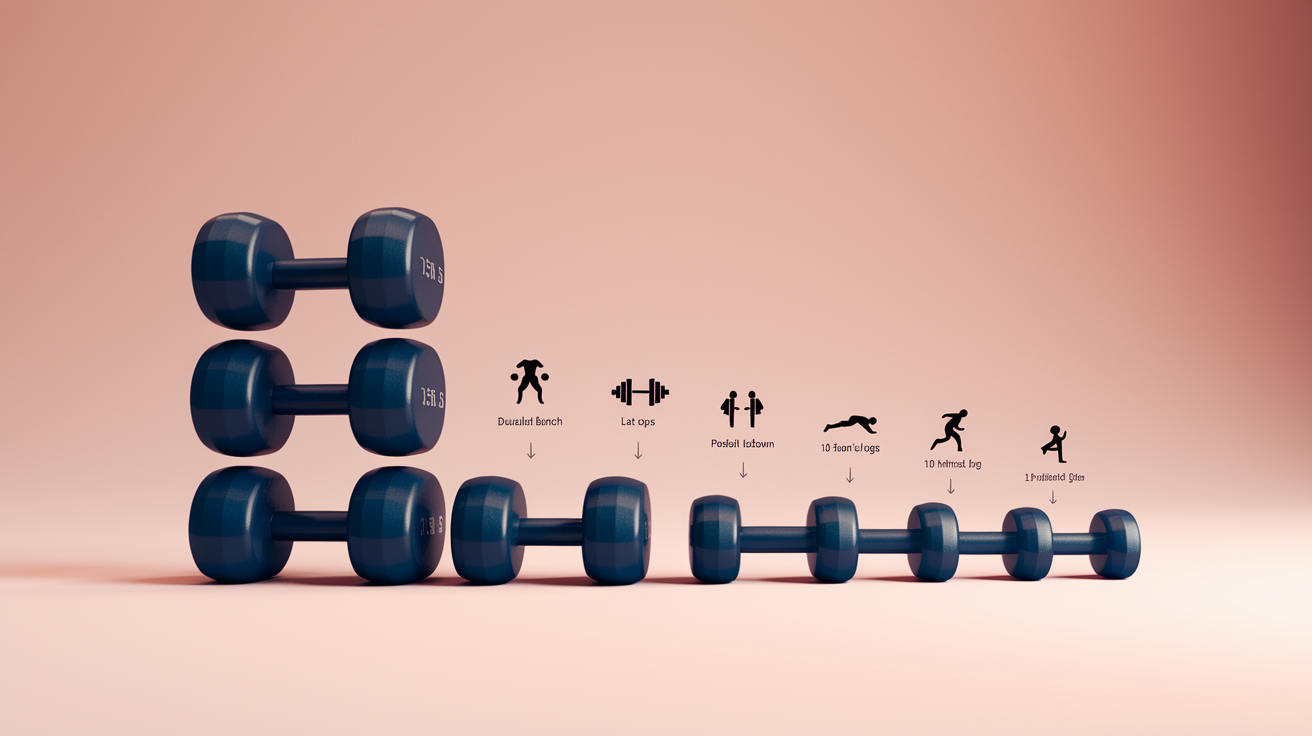
Progressive overload just means you’re asking your muscles to do a little more than they did last week. And for beginners, “a little” really matters. Your body adapts when you nudge the load, reps, or difficulty upward in small steps over weeks and months.
Most people jump too fast. Adding 10 pounds after one solid week feels great in the moment, but it usually ends in sore joints, wobbly form, or a stall. Real progress comes from adding 2.5 to 5 pounds, maybe one or two reps, then letting your body catch up.
Here are six concrete ways to progress in real life:
- Dumbbell bench press – Start with 15-pound dumbbells for 3 sets of 8 reps. Week 2: bump it to 3 sets of 10. Week 4: grab the 17.5-pound dumbbells and drop back to 3 sets of 8.
- Goblet squat – Begin with a 15-pound dumbbell for 3 sets of 10 reps. Week 3: tack on 1 rep per set, hitting 3 sets of 11. Week 5: move up to a 20-pound dumbbell and reset to 3 sets of 10.
- Lat pulldown – Start at 40 pounds for 3 sets of 8 reps. Week 2: add 1 rep per set. Week 4: move the pin to 45 pounds and go back to 3 sets of 8.
- Push-ups – Start with 3 sets of 6 incline push-ups, hands on a bench. Week 2: add 1 rep per set. Week 6: move to the floor and reset to 3 sets of 5.
- 10-minute jog – Jog at an easy pace for 10 minutes. Week 2: add 2 minutes. Week 4: add another 2 minutes. Week 8: pick up your pace by 10 seconds per mile or drop in a 30-second faster interval every 3 minutes.
- Plank – Hold for 20 seconds. Week 2: add 5 seconds. Week 4: hit 30 seconds. Week 8: either hold for 45 seconds or lift one leg for the final 10 seconds.
Pick one type of increase per exercise every one to two weeks. If you added weight last week, keep reps the same this week. If you added reps, don’t touch the weight for at least another week. Once you’re training consistently for four to six weeks, you can add one extra workout day. Rest cuts of 10 to 20 seconds can boost difficulty once you’ve been hitting your target reps and sets comfortably for two straight weeks.
Increasing Weight Safely as a Beginner
Weight progression is one of the clearest ways to see strength gains, but only if you add load slowly enough for your tendons, joints, and connective tissue to keep up. Muscle grows faster than connective tissue repairs. Rush the weight increases and you’ll end up with elbow pain, shoulder tweaks, or lower-back strain.
A safe beginner rule: increase upper-body lifts by 2.5 to 5 pounds every one to two weeks. Lower-body lifts can handle 5 to 10 pounds on the same schedule. If you can complete all your sets and reps with solid form for two sessions in a row, you’re ready to try a small jump.
Here’s how to structure it:
- Load selection – Start with a weight you can lift for your target reps while keeping full range of motion and control. If the final rep of your last set feels shaky or you’re arching your back, the weight’s too heavy.
- Rate of increase – Add 2.5 pounds to dumbbell curls, overhead presses, and tricep work. Add 5 pounds to bench presses, rows, and pulldowns. Add 5 to 10 pounds to squats, deadlifts, and leg presses.
- Barbell vs. dumbbell increments – Barbell jumps are usually 5 to 10 pounds because you’re adding a 2.5- or 5-pound plate to each side. Dumbbell jumps are often 2.5 to 5 pounds total per hand, which is easier on smaller muscle groups.
- Weekly testing guidelines – If you hit your rep target for two straight workouts, test a small weight increase next session. If you complete at least 75 percent of your usual reps with good form, keep the new weight. If you drop below 75 percent or your form breaks down, go back to the previous weight for another week.
Progressing by Reps and Sets
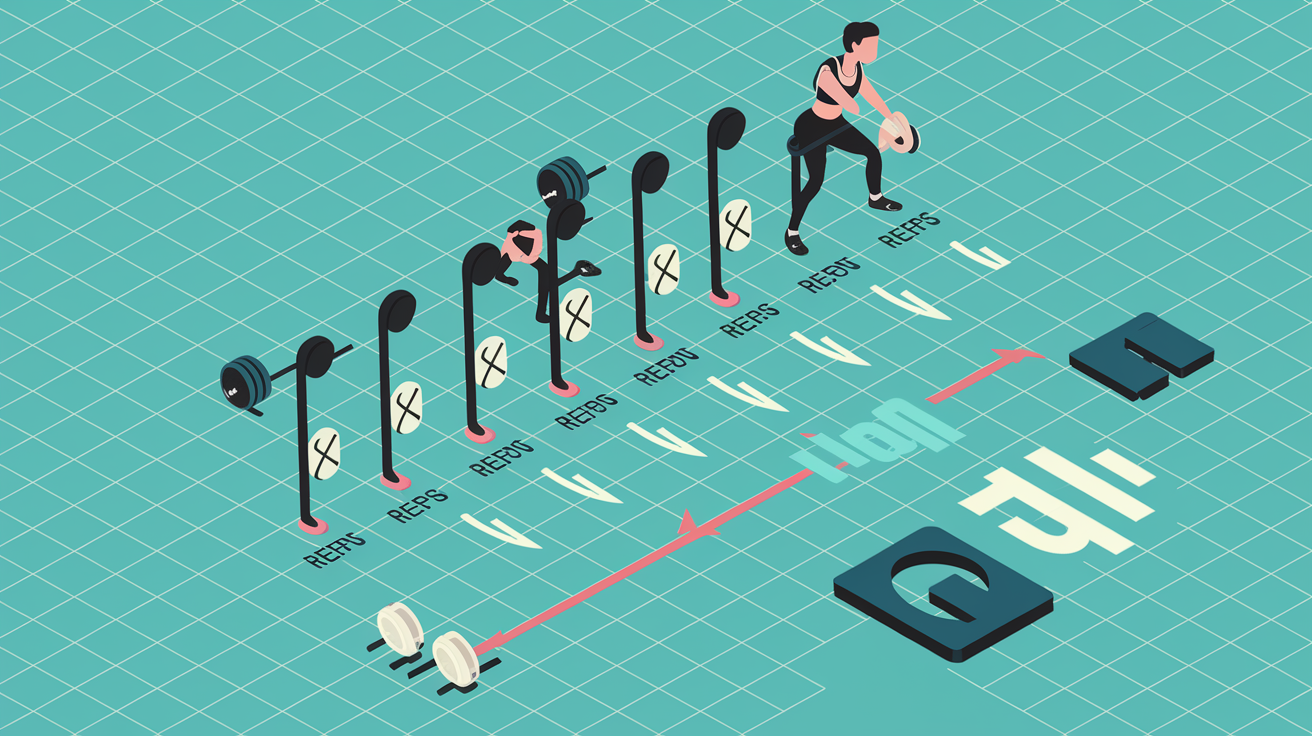
Rep-based progression is the easiest way to overload without needing new equipment or smaller plates. When you can’t add weight yet, you add one or two more reps to each set. That increases total volume and builds endurance before your next load jump.
Here’s how to apply it:
- Rep targets – Most beginners work in an 8 to 12 rep range. Start at the low end (8 reps) and add 1 to 2 reps per week until you hit 12. Once you can complete 3 sets of 12 reps with solid form, bump the weight by 2.5 to 5 pounds and drop back to 3 sets of 8.
- Set adjustments – If your program calls for 2 sets and you can complete them comfortably for two weeks, add a third set. Wait another four weeks before considering a fourth. Most beginners don’t need more than 3 to 4 sets per exercise.
- Upper-body vs. lower-body differences – Upper-body exercises like curls, tricep extensions, and lateral raises often progress one rep at a time. Lower-body moves like squats and lunges can handle 2-rep jumps because the muscles are larger and recover faster.
- Weekly testing – If you added a rep last week and finished all your sets this week, try adding another rep next week. If you couldn’t finish your sets at the new rep count, repeat the same reps for one more week.
- Rep ceilings – Once you hit 12 to 15 reps per set, further rep increases shift you toward endurance rather than strength or size. At that point, it’s time to increase weight and reset your reps lower.
When you’ve been adding reps for three or four weeks and you’re approaching the top of your range, plan your next weight increase. Drop your reps back to the starting number (usually 8), add 2.5 to 5 pounds, and start the rep-progression cycle again. This keeps your training predictable and cuts the risk of jumping weight too soon.
Adjusting Rest Times for Overload

Rest-interval manipulation bumps up workout intensity without changing weight or reps. Shorter rest periods force your cardiovascular system and metabolic pathways to work harder. That can improve conditioning and calorie burn while keeping the load manageable.
Most beginners start with 90 to 120 seconds of rest between sets. After two to three weeks of consistent training, try shaving off 10 to 20 seconds. If you’re resting 90 seconds, drop to 75 or 80 seconds for your next workout. If you can still complete your sets and reps, hold that rest time for another week, then consider another 10-second cut.
Rest reductions work best once you’ve nailed down solid form and can complete your target reps reliably. If cutting rest causes your reps to drop by more than two per set or tanks your technique, go back to your previous rest interval and focus on adding reps or weight instead. Use rest-time overload as a secondary tool, not your main progression method.
Frequency and Volume Progressions

Training frequency is how many times per week you work a muscle group or do a specific workout. Volume is the total number of sets and reps you complete in a session or across a week. Both can be increased gradually to drive adaptation without adding weight.
Most beginners start with two full-body workouts per week, then move to three sessions after four to six weeks of consistent training. Adding a third day spreads your weekly volume across more sessions, which often feels easier to recover from than cramming all your sets into two hard workouts. After another six to eight weeks, some people add a fourth day or split their training into upper and lower days to bump total weekly volume while keeping individual sessions manageable.
Volume progressions usually move from 2 sets per exercise to 3 sets after the first month, then to 4 sets after another six weeks. Each set increase should be tested for at least two weeks before adding another. If your recovery suffers, sleep quality tanks, or soreness lasts longer than 48 hours, hold your current volume and focus on other progression methods like reps or load.
| Frequency | Sets | Timeline |
|---|---|---|
| 2 sessions per week | 2 sets per exercise | Weeks 1–4 |
| 3 sessions per week | 3 sets per exercise | Weeks 5–10 |
| 3–4 sessions per week | 3–4 sets per exercise | Weeks 11+ |
Progressive Overload for Bodyweight Training
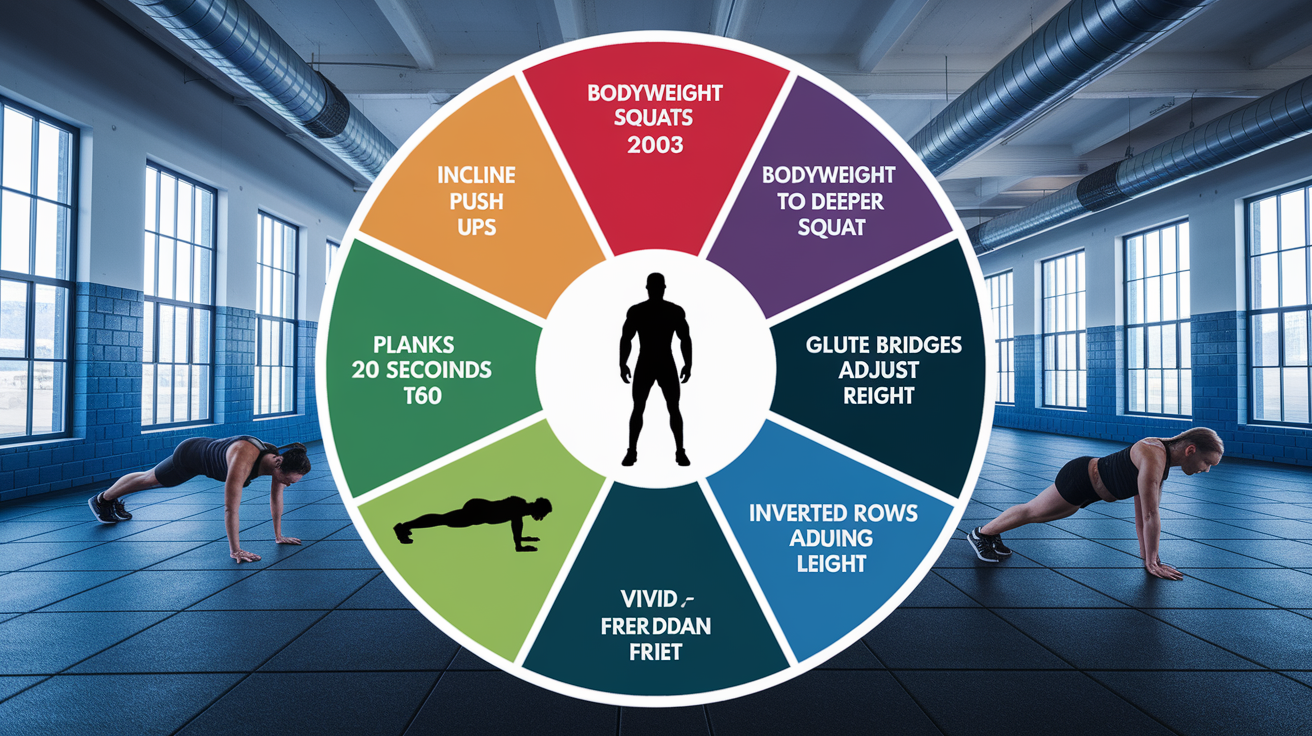
Bodyweight training is often the first step for people who don’t have access to weights or who want to build foundational strength and movement quality before adding load. Progressive overload still applies. You just use reps, tempo, range of motion, and movement variations instead of adding pounds to a bar.
Here are six bodyweight progression paths that work:
- Push-ups – Start with incline push-ups, hands on a bench or countertop. Add 1 rep per set each week. Once you hit 3 sets of 12, move to floor push-ups and reset to 3 sets of 6. After mastering floor push-ups, try decline push-ups (feet elevated) or add a 2-second pause at the bottom.
- Squats – Begin with bodyweight squats for 3 sets of 10. Add 2 reps per week. Once you reach 3 sets of 15, slow your tempo to a 3-second descent. After another four weeks, try single-leg box squats or add a pause at the bottom.
- Planks – Hold for 20 seconds. Add 5 seconds per week. Once you can hold 60 seconds, try lifting one foot off the ground for 10 seconds at a time, alternating feet every 10 seconds.
- Glute bridges – Start with 3 sets of 12 reps. Add 2 reps per set each week. Once you reach 3 sets of 20, switch to single-leg glute bridges and reset to 3 sets of 8 per leg.
- Inverted rows – Use a suspension trainer or barbell set at waist height. Begin with 3 sets of 6 reps. Add 1 rep per week. Once you reach 3 sets of 12, lower the bar height to crank up difficulty or add a 2-second hold at the top of each rep.
- Lunges – Do 3 sets of 8 reps per leg. Add 1 rep per leg each week. Once you hit 3 sets of 12, add a 2-second pause at the bottom or switch to walking lunges to increase difficulty.
Combine rep progression with variation progression by adding one or two reps each week until you hit your ceiling, then switch to a harder version of the movement and drop your reps back down. For example, go from 3 sets of 15 incline push-ups to 3 sets of 6 floor push-ups. This cycle keeps your training challenging without needing equipment.
Cardio Progressive Overload Examples

Cardio overload works the same way as strength training. You increase duration, intensity, or frequency in small steps over weeks. Most beginners start with steady-state cardio at a comfortable pace, then gradually add time, speed, or intervals once their base fitness improves.
Here are five cardio progression examples using specific numbers:
- Treadmill – Start with a 15-minute walk at 3.0 mph. Add 2 minutes per week. Once you reach 30 minutes, bump your speed by 0.2 mph every two weeks. After another month, toss in a 1-minute jog interval every 5 minutes.
- Outdoor running – Begin with a 10-minute easy jog. Add 2 minutes per week. Once you reach 20 minutes, pick one run per week and crank your pace by 10 seconds per mile. After six weeks, add a second weekly run and keep both at your comfortable pace.
- Cycling – Ride for 20 minutes at a moderate effort (you can still talk in short sentences). Add 5 minutes per week. Once you reach 40 minutes, increase your resistance or gear by one notch every two weeks. After another month, add 30-second hard efforts every 5 minutes.
- Rowing – Row for 10 minutes at a steady pace (around 20 strokes per minute). Add 2 minutes per week. Once you reach 20 minutes, bump your stroke rate by 2 strokes per minute every two weeks. After six weeks, add 20-second sprint intervals every 4 minutes.
- Walking – Walk for 20 minutes at a comfortable pace. Add 5 minutes per week. Once you reach 40 minutes, increase your speed by 0.1 mph every two weeks or add a 1-minute faster interval every 10 minutes.
Tracking and Measuring Progress

Tracking turns guesswork into a repeatable plan. When you write down your reps, load, sets, rest times, and how each session felt, you can see patterns, spot stalls, and figure out when to bump difficulty.
Most beginners track using a simple notebook or a notes app. Each entry should include the date, exercise name, weight used, sets completed, reps per set, rest interval, and a quick note about how hard the workout felt. For example: “March 15, dumbbell bench press, 15 lbs, 3 sets of 10, 90 sec rest, felt strong.”
Here’s how to structure your weekly log and measure real progress:
- Weekly log structure – Record every workout on the day you complete it. At the end of the week, review your entries and highlight any exercises where you increased reps, weight, or cut rest. Plan one small change for the following week.
- Rate-of-perceived-exertion scoring – After each set, rate your effort on a 1 to 10 scale. A 7 means you could’ve done 3 more reps. An 8 means 2 more reps. A 9 means 1 more rep. If you’re consistently scoring a 7 or lower, you’re ready to add reps or weight.
- Signs of positive progress – You’re progressing if you complete more total reps than last week, lift the same weight with better form, finish your workout in less time, or feel less sore 24 hours after training. Any of these signals mean your body’s adapting.
- Session frequency tracking – Mark each workout day on a calendar. If you miss more than one session per week for two weeks in a row, your progression plan needs to slow down or your schedule needs adjustment. Consistency beats intensity.
Common Beginner Mistakes and How to Avoid Them

Beginners often stall or get hurt because they misapply progressive overload. The most common errors come from moving too fast, skipping recovery, or losing track of what actually changed week to week.
Here are five frequent mistakes and how to correct them with clear numbers:
- Increasing weight too quickly – Jumping 10 pounds after one good workout overloads your joints and tendons before they’re ready. Stick to 2.5 to 5-pound increases for upper-body lifts and 5 to 10-pound increases for lower-body lifts every one to two weeks. If you can’t complete at least 75 percent of your usual reps with the new weight, drop back.
- Skipping deload weeks – Training hard every week without a planned recovery week leads to fatigue, poor sleep, and stalled progress. Every four to six weeks, cut your weight by 10 to 20 percent or drop your sets by one for a full week. This gives your body time to catch up and adapt.
- Neglecting form – Adding reps or weight while sacrificing range of motion or using momentum doesn’t build strength. It builds bad habits and injury risk. If your form breaks down, stop the set. Use the same weight or reps for another week and focus on control.
- Inconsistent training – Progressive overload only works if you train the same muscle groups at least twice per week, every week. Missing sessions forces you to restart your progression cycle. If you can only train twice a week, plan for that and progress more slowly.
- Ignoring recovery – Overload creates stress. Recovery turns that stress into adaptation. If you’re not sleeping at least 7 hours per night or eating enough protein (a simple target is 0.7 to 1 gram per pound of body weight), your body can’t repair and grow. Track your sleep and protein intake the same way you track your reps.
Use small, steady steps: add 2.5–5 lbs to upper-body lifts, 5–10 lbs to lower-body lifts every 1–2 weeks, or add 1–3 reps per week. You can also shave 10–20 seconds off rest, or move from two to three sessions after 4–6 weeks.
Keep a simple log of load, reps, sets, rest, and sessions—your phone notes work fine. If form starts to suffer, hold the increase or drop back a step.
These progressive overload examples for beginners (increment strategies) give clear, usable steps you can try tonight. Start small, be consistent, and expect steady progress.
FAQ
Q: What is progressive overload and why should beginners use small increments?
A: Progressive overload means slowly increasing training stress so your body adapts; beginners use small increments to protect form, avoid injury, and lock in steady, reliable strength gains.
Q: How much weight should beginners add and how often?
A: Beginners should add about 2.5–5 lbs for upper-body and 5–10 lbs for lower-body every 1–2 weeks, moving slower on harder lifts and when form feels shaky.
Q: How can I use reps and sets to progress without increasing weight?
A: You can increase reps by 1–3 per week until you hit the rep ceiling, then add a set or reset weight—small rep jumps keep progress without heavier loads.
Q: When should I switch from rep progression back to weight progression?
A: Switch from rep progression to adding weight when you consistently reach the top of your rep range for all sets, then raise load and drop reps near the bottom.
Q: How should I reduce rest times to increase difficulty safely?
A: Reduce rest by 10–20 seconds every 1–2 weeks to increase difficulty while keeping movement quality and performance solid between sets.
Q: How often should beginners increase training frequency and volume?
A: Beginners should move from two sessions to three per week after about 4–6 weeks; increase sets from 2 up to 3–4 over similar 6‑week blocks as recovery allows.
Q: Can you give beginner progression examples for common exercises?
A: Progressions: dumbbell bench +2.5–5 lbs weekly; goblet squat +5–10 lbs; lat pulldown +5 lbs or +2–3 reps; push‑ups add 2–5 reps or incline→flat→decline; 10‑min jog add 1–2 minutes; plank add 10–20s.
Q: How should beginners select load and rate of increase for lifting?
A: Choose a weight you can control with good form for target reps; increase upper-body by 2.5–5 lbs and lower-body by 5–10 lbs every 1–2 weeks, testing weekly.
Q: How do I progress cardio like running or walking?
A: Progress cardio by adding 1–2 minutes per week, shaving 5–10 seconds per mile for pace, or adding one interval per session while keeping effort moderate.
Q: What should I track to measure progress and how simply?
A: Track reps, load, sets, rest, session frequency, and RPE weekly. Use a quick phone note or paper log and note one clear weekly win (more reps, heavier load, or less rest).
Q: What common beginner mistakes should I avoid and how?
A: Common mistakes are adding weight too fast, skipping form, training inconsistently, ignoring recovery, and skipping deloads; fix them with small increases, form-first sets, and planned easy weeks.