

Think more workouts mean faster gains? Not for beginners.
Your body needs time to learn movements and recover, so piling on sessions or sets usually backfires.
Most beginners should train 2–4 days per week and aim for about 6–10 hard sets per muscle each week.
This keeps progress steady, technique clean, and soreness manageable.
In this post you’ll get a simple way to choose frequency and weekly volume that fits your schedule and lets you improve week after week.
Beginner-Friendly Training Setup

Training 2–4 days per week is where most beginners should land. Your body needs time to adapt to new movements and actually build muscle, not just pile on fatigue. Two days is the minimum if you want real progress. Four days gives you more sessions to spread the work around without crushing yourself in any single workout. Three days? That’s the middle ground, and it works great if you’re juggling a job, family, and trying to figure out how to squat without feeling like you’re going to fall over.
Start with 6–10 total weekly sets per muscle group. A set is just one round of an exercise. Like one set of 8 squats. If you’re training chest twice a week, maybe you do 4 sets Monday and 4 sets Thursday. That’s 8 total. This amount triggers growth and strength without leaving you wrecked for the next session. Push much higher too soon and you’re just sore and tired, which means your next workout suffers.
These ranges work because beginners respond fast to small amounts of training. Your nervous system is learning patterns, your muscles are adapting to load, your tendons and ligaments are strengthening. Adding extra days or extra sets doesn’t speed that up. It just adds fatigue before you’ve built the foundation to handle it.
• Train 2–4 days per week depending on your schedule and how you recover.
• Aim for 6–10 total weekly sets per muscle group.
• Stick to basic compound exercises like squat, bench, row, press.
• Take at least one full rest day between training sessions.
Understanding Training Volume

Training volume is the total number of hard sets you do for a muscle group each week. A hard set means you’re working close enough to failure that the last couple reps feel difficult. If you do 3 sets of squats Monday and 3 sets Thursday, your weekly quad volume is 6 sets. Volume drives growth and strength, but only if you can recover from it. Beginners grow well on moderate volume because their muscles haven’t adapted yet, so a smaller dose gets a strong response.
Most beginners should target 6–10 weekly sets per muscle group. Don’t go higher until that volume stops working. Exceeding this range early usually just lowers the quality of each set. You get too tired to keep good technique or push hard on later sets. It’s better to do 8 high-quality sets than 15 sloppy ones. As you gain experience over months, you can slowly add sets if progress stalls. But start conservative and let consistency do the work.
| Metric | Definition | Beginner Target |
|---|---|---|
| Weekly sets | Total hard sets per muscle group across all sessions | 6–10 sets |
| Sets per session | Hard sets for one muscle group in a single workout | 3–5 sets |
| Rep ranges | Number of reps performed in one set | 5–10 for strength; 8–12 for hypertrophy |
| Exercises per muscle group | Different movements targeting the same area per week | 1–2 exercises |
Common Beginner Training Splits

A training split is how you divide your weekly workouts across different days. Choosing the right split helps you hit that 2–4 day target and distribute 6–10 weekly sets per muscle group without overloading any single session.
Full Body (2–3 Days/Week)
Full body workouts train all major muscle groups in each session. You might squat, bench press, and row on Monday, then repeat the same or similar exercises Wednesday and Friday. This works well for 2–3 days per week because you get multiple exposures to each movement pattern without needing a complicated schedule. Each session stays relatively short, often under an hour, and you can keep volume per session manageable by doing 3–4 sets per exercise. Full body also lets you practice the same lifts frequently, which speeds up skill acquisition when you’re still learning proper form.
Upper/Lower (3–4 Days/Week)
An upper/lower split alternates between upper body and lower body workouts across the week. A typical layout is upper Monday, lower Tuesday, rest Wednesday, upper Thursday, lower Friday. This fits 4 training days and gives each muscle group two exposures per week with moderate volume per session. You can do 4–5 sets for each major muscle group per session without sessions dragging past 60–75 minutes. The alternation also lets your upper body recover while you train legs, and vice versa, which helps manage fatigue better than doing full body sessions on consecutive days.
Introductory 3-Day Split
A simple 3-day split might look like push (chest, shoulders, triceps) on Monday, pull (back, biceps) on Wednesday, and legs (quads, hamstrings, glutes) on Friday. This spreads work across the week and keeps session length reasonable. Each session focuses on related muscle groups, so you can complete 6–9 total sets for each area in one workout and hit that 6–10 weekly set target without needing multiple exposures. It’s a step up from full body in terms of volume per session but still avoids the excessive splitting and session frequency that often leads beginners to skip workouts or burn out.
How Progressive Overload Works

Progressive overload means gradually increasing the challenge of your training over time. You can add reps (moving from 3 sets of 8 to 3 sets of 10), add load (using 135 pounds instead of 125), improve your technique so you work the target muscle harder, or add sets (going from 3 to 4 sets). All four methods work. You’ll use different ones depending on what you can recover from and what fits your program. Most beginners find adding reps or load the simplest to track and apply week to week.
Beginners respond quickly to overload because your nervous system and muscles haven’t seen consistent resistance training before. Adding 5 pounds to the bar or squeezing out one extra rep per set is often enough to trigger adaptation. After a few months, those jumps get smaller and progress slows. But early on you can ride steady, simple increases for a long time. The key is making the change small enough that you don’t sacrifice technique or accumulate fatigue faster than you recover.
Apply overload conservatively by changing only one variable at a time. Wait a week or two to see if you adapted. If you added 10 pounds and completed all your reps with good form, stick with that weight for another session or two before adding more. If you missed reps or your form broke down, repeat the same weight until it feels manageable. Patience here prevents injury and keeps you progressing for months instead of stalling out in weeks because you pushed too hard too soon.
Recovery and Fatigue Management

Beginners generally need 24–48 hours of rest between sessions that train the same muscle groups. If you do a full body workout Monday, scheduling the next one Wednesday gives your muscles, nervous system, and connective tissue time to repair and adapt. Training the same muscles again before that window closes often leads to diminishing returns. You show up still sore, your performance drops, and you accumulate fatigue without getting stronger or bigger. Spacing sessions out lets each workout be high quality instead of grinding through fatigue.
Too much volume or too many training days leads to persistent soreness, declining strength, and poor performance in the gym. If you can’t match last week’s reps or weight, and you’re getting enough sleep and food, you’re likely training more than you can recover from. Sleep is the most powerful recovery tool you have. Aim for 7–9 hours per night. Nutrition matters too. Eating enough protein (around 0.7–1 gram per pound of body weight daily) and total calories supports muscle repair and growth. Manage life stress where you can, because high stress outside the gym reduces your capacity to recover from training stress.
• Take at least one full rest day between sessions that work the same muscles.
• Prioritize 7–9 hours of sleep per night for optimal recovery.
• Eat consistent protein (around 0.7–1 gram per pound daily) and enough total calories to support training.
Avoiding Common Beginner Mistakes
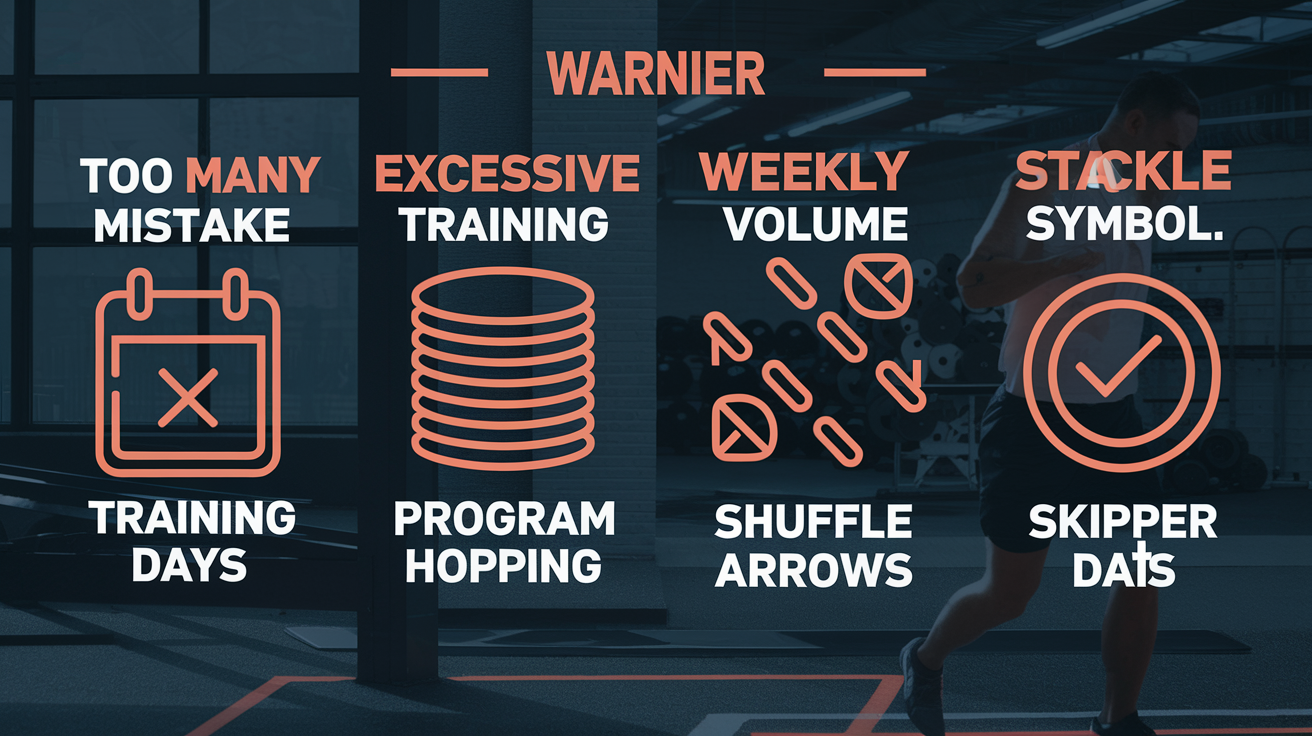
Training too many days per week is one of the most common beginner errors. The belief that more is always better leads people to train 5–6 days per week right away, often with high volume per session. Your body doesn’t have the work capacity or recovery systems built up yet, so you end up fatigued, sore, and unable to perform well. Stick to 2–4 days per week and let your body adapt before adding more frequency.
Using excessive volume too soon is closely related. Beginners sometimes copy advanced programs with 15–20 sets per muscle group per week, thinking it’ll accelerate results. Instead, it just creates soreness and fatigue that interfere with the next workout. Start with 6–10 weekly sets per muscle and add volume only when progress stalls. Skipping rest days, changing programs every few weeks (program hopping), and adding unnecessary exercise variety also sabotage progress by preventing you from building a consistent base of strength and skill on a few key lifts.
• Training more than 4 days per week before your body adapts.
• Using 15+ weekly sets per muscle group when 6–10 sets would produce the same or better results.
• Program hopping. Switching routines every 2–3 weeks instead of sticking with one for at least 8–12 weeks.
• Skipping rest days or training the same muscles on consecutive days without enough recovery time.
Final Words
We gave a clear, simple plan: train 2–4 days a week, aim for about 6–10 sets per muscle, choose a full‑body or basic split, and use small, steady progress steps.
Do this today: pick 2–3 training days and sketch one full‑body session with 6–10 sets for each major muscle group. Keep exercises basic and rest between sessions.
This approach makes progress consistent and recoverable. You’ll get more confident at choosing training frequency and weekly volume as a beginner — keep it simple and keep going.
FAQ
Q: What is the best training frequency for beginners?
A: The best training frequency for beginners is 2–4 days per week, which balances learning lifts, recovery, and steady progress. Start with two full‑body sessions or three shorter sessions and adjust.
Q: How many sets per muscle group should beginners do each week?
A: Beginners should do 6–10 weekly sets per muscle group as a starting volume; it gives enough stimulus for gains while allowing recovery. Track weekly sets, not just per session.
Q: What does a simple beginner workout structure look like?
A: A simple beginner workout structure uses full‑body routines with 3–6 compound exercises, 2–4 sessions weekly, and aims for 6–10 weekly sets per muscle. Prioritize technique and consistency.
Q: What is training volume and how should beginners use it?
A: Training volume is the total sets per muscle group across a week. Beginners should target 6–10 weekly sets and avoid increasing volume before form and recovery are solid.
Q: Which split should a beginner choose: full‑body, upper/lower, or a 3‑day split?
A: The best split depends on your schedule: full‑body for 2–3 days, upper/lower for 3–4 days, or an introductory 3‑day split. All keep exercises basic and weekly volume around 6–10 sets.
Q: How should beginners apply progressive overload?
A: Progressive overload for beginners means slowly adding reps, weight, better technique, or sets. Increase one small step at a time and track lifts to keep steady strength gains without injury.
Q: How much rest do beginners need between sessions?
A: Beginners need about 24–48 hours rest between similar sessions; quality sleep and consistent nutrition also speed recovery. If soreness persists, reduce volume or choose an easier session.
Q: What common mistakes do beginners make with frequency and volume?
A: Common beginner mistakes are training too many days, using excessive weekly volume, skipping rest, and switching programs too often. Fix these by simplifying and tracking progress for several weeks.
Q: How quickly will beginners see strength or body changes?
A: Beginners usually notice strength gains in 2–8 weeks and visible body changes over months. Focus on consistent sessions, gradual overload, and simple tracking to measure progress.
Q: What’s a quick starter plan I can use tonight?
A: A quick starter plan is train 2–4 days, pick 3 compound moves per session, aim for 6–10 weekly sets per muscle, and record weight or reps each workout.