

What if the fastest way to get stronger is to add almost nothing to the bar?
Big jumps stall progress, wreck sets, and put your joints at risk.
Microprogressions are planned tiny weight bumps (0.25–2 kg) that let your muscles, joints, and nervous system adjust, so you keep adding weight without wrecking form or stalling.
Read on for clear rules, practical increment sizes by lift, tools for microloading, and simple tracking habits that turn tiny steps into 12 to 26 kg of gains over a year.
Core Principles of Small Weight Increases for Steady Strength Gains

Microprogressions are planned, really small weight bumps. We’re talking 0.25 to 2 kg (0.5 to 5 lb) added to your lifts so you keep getting stronger without the big jumps that stall you out, wreck your sets, or put your joints at risk. The whole idea is pretty straightforward. Instead of forcing your body to handle a sudden 5 kg jump, you nudge things up by 0.5 or 1 kg. Your muscles, joints, and nervous system get time to adjust without freaking out. Most coaches will tell you to aim for somewhere between 0.5 and 1.5% per step forward. If your standard 2.5 kg jump is more than about 2 to 3% of what you’re working with, microloading is the move.
The math actually matters here, especially if you’re lighter. Adding 5 kg to a 50 kg bench is a 10% jump. Adding that same 5 kg to a 100 kg bench? Only 5%. For the lighter lifter, that 10% feels like hitting a wall. You miss reps, your form falls apart, and you start dreading the lift. Microloading keeps the increment matched to your current strength so the relative stress stays manageable and your technique stays clean.
Tiny increments add up fast when you stick with them. Toss on 0.25 kg per week and you’re up roughly 13 kg in a year. Go with 0.5 kg per week and that’s around 26 kg annually. These aren’t made-up numbers. Lifters who stay consistent with micro-increments regularly add 13 to 26 kg to their main lifts over 12 months, and some push past 50 kg over two years just by dodging the stalls that come from oversized jumps.
Essential microloading increment guidelines:
- Upper body compound lifts (bench, press): 0.25 to 1 kg per session (0.5 to 2 lb)
- Lower body compound lifts (squat): 0.5 to 2 kg per session (1 to 5 lb)
- Deadlift: 1.25 to 5 lb depending on how often you pull and how close you are to your max
- Isolation and machine work: 0.25 to 1 kg for curls, lateral raises, leg extensions
- Target percent bump: 0.5 to 1.5% per step to keep the gains coming
Practical Loading Standards: How Micro-Increments Work Across Exercises

Fractional plates are what most people use. Standard sizes include 0.25 kg and 0.5 kg plates that you stick on each side of a barbell for total increases of 0.5 or 1 kg per lift. Weighted collars can weigh less than 0.125 kg, and wrist weights come in 0.25 to 1 kg sizes, giving you even finer control. For barbell stuff, you can step up by as little as 0.25 kg per session or go as high as 2.5 kg depending on the exercise and how often you train it. Cable machines and weight stack machines usually jump in 5 kg chunks, which is way too big for steady progress. To get around that, lifters use magnetic add-on weights or place small plates right on the weight stack pin. That turns a 5 kg jump into a 1 or 2 kg climb.
Dumbbells and kettlebells are trickier because most gyms stock fixed weights with huge gaps. Moving from a 3 kg dumbbell to a 5 kg one is a 66% increase. That’s absurd for consistent progress. Instead, you can attach small plates using straps or bands, or wear wrist weights during the set to add 0.25 to 1 kg. Keeps the jump small and saves you from repeatedly failing to handle the next fixed dumbbell sitting there mocking you.
| Exercise Type | Typical Default Jump | Recommended Micro Jump | Tools Needed |
|---|---|---|---|
| Barbell compound lifts | 2.5 to 5 kg (5 to 10 lb) | 0.25 to 1 kg (0.5 to 2 lb) | Fractional plates, weighted collars |
| Cable/selectorized machines | 5 kg (10 lb) | 1 to 2 kg (2 to 5 lb) | Magnetic plates, small plates on pin |
| Fixed dumbbells | 2 to 5 kg (5 to 10 lb) | 0.25 to 1 kg (0.5 to 2 lb) | Wrist weights, straps with micro plates |
| Weight-stack machines | 5 kg (10 lb) | 1 to 2 kg (2 to 5 lb) | Magnetic weights, pin-attachable plates |
Programming Microprogressions: Rep Targets, Frequency, and Monthly Math

How often you train a lift determines how fast the micro-increments pile up. Bench twice a week and add 0.5 kg each session? You gain 1 kg per week. That’s roughly 4 kg per month or 12 kg in three months. Squat once a week with a 2.5 kg bump each time? You’re adding 10 kg per month. The math is simple, but knowing when to add weight and when to hold steady is where most people mess up.
Most lifters want to finish each work set with 1 to 3 reps left in the tank (1 to 2 RIR during strength phases). If you nail all your planned sets and reps at the target effort level, usually an RPE of 7 to 8, you’re ready to add the micro increment next session. If you miss target reps or your top set feels like an RPE 9 or higher, repeat the same weight or think about a small reduction. This keeps you moving forward without grinding yourself into the floor every week.
When progress stalls for 2 to 3 sessions in a row (you can’t complete the reps despite solid effort), deload by 5 to 10% and rebuild using the same micro increments. This reset lets your nervous system and connective tissues recover while you keep practicing the movement under manageable loads. The deload isn’t failure. It’s built into long-term strength development.
Tracking your lifts isn’t optional. Log the exact weight, sets, reps, and how it felt after every session. This kills the guesswork and makes it obvious when you’re ready to add 0.25 kg or when you need an extra week at the current load. Over weeks and months, your log becomes a visual record of consistent micro gains that stack into major strength increases.
Session-to-session rules for adding weight:
- Complete all target sets and reps with 1 to 3 reps in reserve? Add the planned micro increment next session.
- Miss target reps or finish at RPE 9+? Repeat the same weight next session.
- Fail to complete reps for 2 to 3 sessions straight? Deload 5 to 10% and rebuild with micro increments.
- Feel aches, joint stress, or technique breakdown? Hold weight steady or reduce slightly and focus on form.
- Training a lift 3+ times per week? Use smaller per-session increases (like 0.25 kg instead of 0.5 kg).
- Training a lift once per week? Larger per-session increases (1 to 2 kg) are often doable.
Exercise-Specific Microprogression Guidelines for Squat, Bench, Deadlift, and Press

Different lifts handle different increment sizes because of muscle mass involved, nervous system demands, and recovery speed. Upper body pressing moves slower than lower body stuff, and overhead press climbs slower than bench. Getting this helps you set realistic expectations and avoid frustration.
Bench Progression
Bench press responds well to 0.25 to 1 kg per session. Here’s a real example. Start with 3 sets of 5 reps at 60 kg. Add 0.5 kg each session (60, 60.5, 61, 61.5, and so on). Bench twice a week? You gain 1 kg per week. Over a 12 week training block, you might climb from 60 kg to around 67 kg, assuming you hit one or two small deloads along the way. That’s a 2.5% increase per session, a pace that keeps technique solid and joints healthy. If you stall for two sessions, drop back to around 55 kg (a 5 to 10% cut) and work back up with the same 0.5 kg steps.
Squat & Deadlift Progression
Squat can handle 1 to 2.5 kg per session, depending on frequency. Squat twice a week? 1 kg per session is common. Once a week? 2.5 kg jumps often work. Deadlift progression varies with style and frequency. Many lifters use 1.25 to 5 lb (roughly 0.5 to 2.5 kg) jumps. One example from the field: a lifter moved from 140 kg to 157.5 kg over 8 weeks using 2.5 kg steps per session. That’s a 12.5% gain in two months just by sticking to small, consistent adds and avoiding missed lifts.
Overhead Press Microsteps
Overhead press is the slowest moving major lift for most people. Adding 0.25 to 0.5 kg per week is realistic. Start at 35 kg for 3 sets of 6 reps. You might hit 36 to 37 kg after 4 weeks, and 38 to 41 kg after 12 weeks if progress holds. That 0.5 kg per week pace adds up to roughly 6 kg over three months, which is a big deal for a lift where even 2.5 kg jumps often cause stalls. Patience and micro-increments keep the press moving when larger jumps would’ve stopped you weeks earlier.
Programming Templates Using Small Increments for Long-Term Progress
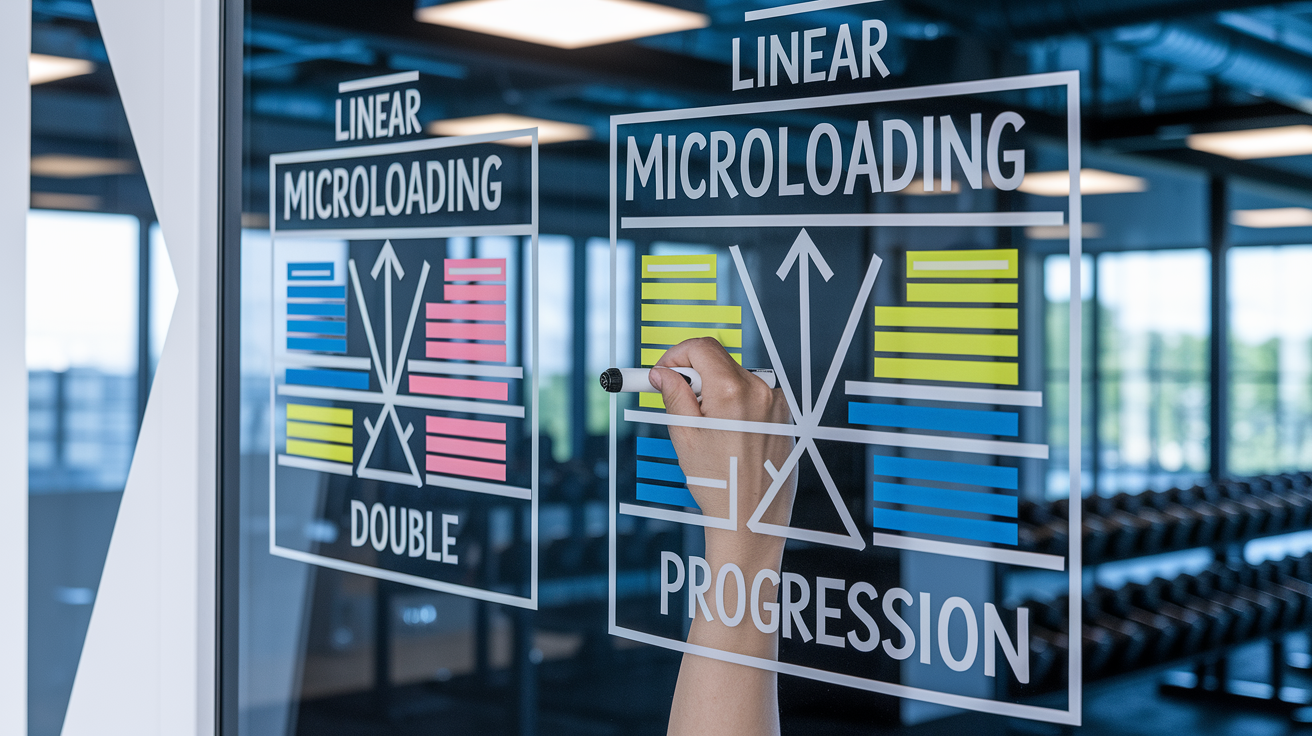
Choosing a structured template makes microloading systematic rather than random. Templates give you clear rules for when to add weight, when to add reps, and when to reset. The simplest approach is linear microloading: add a fixed micro amount each session while keeping sets and reps constant. More advanced lifters often use block periodization, where micro-increments climb over 4 to 8 weeks before a planned deload and scheme change.
Linear Microloading Template
Pick a target set and rep scheme (like 3 sets of 5 reps) and a starting weight that lets you finish each set with 1 to 2 reps in reserve. Each session, add 0.5 to 1 kg (or 1 to 2.5 lb) to the bar. Keep adding weight as long as you complete all sets and reps at the target effort. When you fail to hit reps for 2 to 3 sessions, deload 5 to 10% and rebuild with the same micro increments. This works well for intermediate lifters who’ve exhausted simple 2.5 kg jumps but still have room for session-to-session gains.
Double Progression Template
Double progression bumps reps first, then weight. Choose a rep range, like 3 sets of 6 to 8 reps. Start at the bottom (3 sets of 6). Each week, add one rep per set until you hit the top (3 sets of 8). Once you complete all sets at 8 reps, add 0.5 to 1 kg and drop back to 3 sets of 6. Repeat. This method is forgiving because you can make progress by adding reps even on weeks when adding weight feels too hard. Really useful during high stress life periods or when you’re coming back from a layoff.
4 to 8 Week Block Microloading Template
Block templates keep sets and reps constant (like 4 sets of 4 reps) and add 0.5 to 1.5% per week over a 4 to 8 week block. After the block, deload by 5 to 10% and change the rep scheme (shift to 3 sets of 6, for example). This builds intensity gradually, allows planned recovery, and prevents the monotony of endless linear progression. Advanced lifters and competitors use blocks to peak for meets or testing weeks while managing fatigue.
Weekly microprogression expectations:
- Week 1: Start at 95% of recent best for chosen rep scheme, complete all sets with 1 to 2 RIR
- Week 2 to 4: Add 0.5 to 1.5% (typically 0.5 to 1 kg) each week if sets completed as planned
- Week 5 to 6: Continue micro adds or hold weight steady if fatigue piles up, monitor RPE closely
- Week 7 to 8: Final micro add or repeat previous week’s weight, then deload 5 to 10% and change scheme or begin new block
Tools and Equipment for Microloading Without Large Jumps

The most useful tool is a set of fractional plates weighing 0.25 to 1 kg (0.5 to 2 lb). A basic pair of 0.25 kg plates and a pair of 0.5 kg plates covers most needs. Many commercial gyms don’t stock fractional plates, so serious lifters bring their own in a small bag. Weighted collars that weigh less than 0.125 kg are another option, especially when you want the smallest possible bump. Wrist weights in 0.25 to 1 kg sizes work well for dumbbell exercises, goblet squats, or any movement where you can wear them without messing with your grip or bar path.
Magnetic add-on plates are popular for cable machines and weight stacks. These small discs stick right to the metal plates or weight stack, letting you add 0.5 to 2 kg without changing pins or hunting for loose plates. Some lifters use resistance bands looped around dumbbells or barbells to create variable resistance that adds a micro increment at the hardest part of the lift. If you train at a minimalist gym or at home, a small investment in microplates or magnetic weights unlocks months of consistent progress that would otherwise stall.
Alternative microloading tools:
- Magnetic add-on plates (0.5 to 2 kg) for cable stacks and machines
- Small weight plates (1.25 kg) placed on weight stack pins to bridge 5 kg jumps
- Resistance bands wrapped around barbells or dumbbells for variable micro resistance
- Ankle or cuff weights (0.25 to 1 kg) worn during dumbbell or bodyweight exercises
- DIY options like washers, chains, or small sandbags attached via carabiners or straps
Breaking Plateaus with Micro-Increments and Autoregulation

Plateaus happen when the stress of the next increment exceeds your current recovery and adaptation capacity. Standard 2.5 to 5 kg jumps often cause plateaus because the relative increase is too large, especially on upper body lifts or for lighter lifters. Microloading shrinks the size of each stress step, giving your body time to adapt without triggering failed sets or technique breakdown. When you do stall (can’t complete target reps for 2 to 3 sessions), microloading makes the reset less painful. Instead of dropping 10 kg, you drop 2 to 3 kg and rebuild with 0.5 kg steps.
Autoregulation is adjusting your training based on how you feel and perform each session. Use RPE or RIR to guide your decisions. If your planned weight feels unusually heavy during warm-ups or your top set climbs to RPE 9 when it should be an 8, hold the weight steady or reduce slightly. If sets feel easier than expected and you finish with 3 or 4 reps in reserve, consider adding a micro increment ahead of schedule. This real-time adjustment stops you from blindly adding weight into a wall of fatigue.
When weight increases aren’t possible, adjust other stuff. Add one rep per set, slow your eccentric tempo by one second, shorten rest periods by 15 to 30 seconds, or improve range of motion. These are “difficulty microloads” that bump training stimulus without changing the number on the bar. Over a few weeks, these adjustments build work capacity, and when you return to adding weight, the lifts often feel easier.
Plateau response steps:
- Recognize the stall: missed target reps for 2 to 3 consecutive sessions despite good effort and sleep
- Deload the lift: reduce weight by 5 to 10% (like 60 kg down to 54 to 57 kg)
- Rebuild with micro increments: use 0.25 to 0.5 kg steps and aim for 1 to 2 RIR on all sets
- If plateau repeats after rebuild, change rep scheme (like 3×5 to 4×4 or 3×8) or add volume to assistance exercises targeting weak points
Tracking Strength Gains and Measuring Long-Term Progress

Consistent tracking is the foundation of successful microloading. After every session, log the exact weight lifted, sets, reps, and perceived effort (RPE or RIR). Add notes about technique quality, energy level, sleep, and any aches or joint discomfort. This record gets rid of the guesswork that leads to random oversized jumps or unnecessary resets. When you look back over 4 or 8 weeks, you see whether your micro increments are piling up into real strength gains or whether you need to adjust frequency, volume, or recovery practices.
Success metrics for microloading include absolute load increases over time, completion of target sets and reps within the planned RIR range, and reduced frequency of missed lifts. If you’re adding 0.25 to 0.5 kg per week and completing your planned sets, you’re succeeding. If you’re frequently missing reps or experiencing technique breakdown, either the increment size is too large, your recovery isn’t sufficient, or your starting weight was set too optimistically. Adjust and keep going.
Long-term progress compounds faster than most lifters expect. A 0.5 kg weekly increase on bench press adds 26 kg over one year. For a lifter starting at 60 kg, that’s a climb to 86 kg. A 43% strength gain just by adding a small plate each week and avoiding unnecessary stalls. Over two years, the same pace could add 50 kg or more, assuming periodic deloads and smart autoregulation. These aren’t best case scenarios. They’re typical results for intermediate lifters who track consistently and resist the urge to chase large jumps.
| Timeframe | Typical Microload Gain | Example Outcome |
|---|---|---|
| Weekly | 0.25 to 1 kg per lift | Bench 60 kg → 60.5 or 61 kg |
| Monthly | 1 to 4 kg per lift | Bench 60 kg → 64 kg (4 weeks at 1 kg/week) |
| Yearly | 13 to 26 kg per lift | Bench 60 kg → 73 to 86 kg (0.25 to 0.5 kg weekly) |
Microloading Mistakes and Solutions for Consistent Steady Gains
The most common mistake is adding weight despite poor form or incomplete reps. If your technique breaks down (hips shoot up early on squats, elbows flare on bench, or you lose neutral spine on deadlifts), the weight is too heavy, even if it’s only a 0.5 kg increase. Hold the weight steady or reduce slightly until you can complete all reps with clean technique and 1 to 2 reps in reserve. Another frequent error is ignoring accumulated fatigue. Microloading doesn’t eliminate the need for deloads. It just spaces them out and makes them less severe. Plan a deload every 4 to 12 weeks depending on your volume and intensity.
Forgetting plate math is surprisingly common. If you add a 0.25 kg plate to each side of the bar, you’ve added 0.5 kg total. If you accidentally add 0.5 kg per side, you’ve jumped 1 kg, which might be more than your program called for. Double check your arithmetic, especially when tired or distracted. Some lifters also expect microloading to work forever. Linear progress, even with tiny increments, eventually slows. After several months of consistent micro gains, you’ll need to switch to block periodization, undulating schemes, or other methods to keep moving.
Classic microloading mistakes and fixes:
- Adding weight despite missed reps or technique breakdown? Hold weight steady or reduce 5% and rebuild.
- Ignoring accumulated fatigue and skipping planned deloads? Schedule a 5 to 10% deload every 4 to 12 weeks.
- Using oversized micro jumps (like 2 kg when 0.5 kg is right)? Reduce increment size to match lift and frequency.
- Forgetting to account for both sides of the bar when adding plates? Double check total weight added before lifting.
- Expecting eternal linear gains without program variation? Plan block changes, rep scheme rotations, or exercise swaps after 8 to 16 weeks.
- Not tracking exact weights, reps, and RPE? Start a simple log (notebook, phone app, or spreadsheet) and update after every session.
Final Words
You learned how tiny, steady jumps keep strength moving: what microprogressions are, why 0.25–2 kg steps stop plateaus, and how percent-based increases guide your choices. We also covered tools (fractional plates, wrist weights), session rules, and simple tracking so progress shows up on paper.
Tonight, note your main lift, reps, and how it felt in your phone. If you hit your target, add 0.25–0.5 kg next session.
microprogressions adding weight in small increments for steady gains is a simple, low-friction plan. Keep at it — small wins build big strength.
FAQ
Q: What is the 3 3 3 rule for weight lifting and what is the 2 2 2 rule in weightlifting?
A: The 3-3-3 and 2-2-2 rules are progression triggers: 3-3-3 means you hit your target reps/sets across three consecutive sessions before adding weight; 2-2-2 requires two successful sessions to increase weight.
Q: What is it called when you gradually increase weight and what increments should you increase weights?
A: Gradually increasing weight is called progressive overload or microloading. Use microprogressions of ~0.25–2 kg (about 0.5–1.5% of working weight); smaller lifters should use the smallest jumps (eg. +0.25–0.5 kg weekly).