

What if the “perfect” rep range isn’t the same for everyone?
If your goal is to lift heavier fast, low reps (1–5) teach your nervous system to produce more force.
If you want noticeable muscle size, moderate reps (8–12) build tension and the metabolic stress that grows fibers.
This post cuts through the noise and gives simple, beginner-friendly rep ranges, rest times, and progress rules so you can pick the right plan—or mix both—without guesswork.
Core Rep Range Guidelines for Beginners Seeking Strength vs Hypertrophy

Strength training usually means 1–5 reps per set at around 85–100% of your one-rep max. You’re looking at 4–6 sets per exercise with 3–5 minutes of rest between sets. Hypertrophy training tends to use 6–12 reps per set (8–12 in most real-world programs) at about 75–85% of your one-rep max, split into 3–5 sets per exercise, with 60–90 seconds of rest. Both work for beginners. But they push your body in different directions. Strength training teaches you to produce more force. Hypertrophy training builds more muscle tissue.
Pick your rep range based on what you’re actually after. If you want to lift heavier weights faster (think improving your squat or deadlift numbers), go with the 1–5 rep range and longer rest. If you want to build noticeable muscle size and definition, go with 8–12 reps and shorter rest. You’ll get some overlap either way. Strength work builds some muscle. Hypertrophy work increases some strength. But your primary rep range steers the main adaptation.
Five practical rules to follow as a beginner:
- Use 1–5 reps per set when your goal is maximum strength. Use 8–12 reps per set when your goal is maximum muscle growth.
- Rest 3–5 minutes between heavy strength sets. Rest 60–90 seconds between moderate hypertrophy sets.
- Master technique with lighter loads before adding weight. Don’t add external weight until you can complete all target reps with clean form.
- Start with roughly 10–12 total sets per muscle group each week, spread across 2–3 sessions.
- Progress by adding one rep, one set, or 5 pounds every 1–2 weeks, depending on which variable feels most sustainable.
You can combine both rep ranges in the same week or even the same session. A common beginner approach is to start each workout with one heavy compound lift in the 3–5 rep range, then follow with accessory movements in the 8–12 rep range. This gives you strength gains on key lifts and muscle growth from higher volume work, without requiring two separate training phases.
Physiological Reasons Behind Strength vs Hypertrophy Rep Ranges

Early strength gains in beginners come mostly from neuromuscular adaptations. Your brain and nervous system learning to recruit muscle fibers more efficiently and fire them in better coordination. Studies commonly report noticeable strength increases within 2 to 12 weeks, often before you see much change in muscle size. Heavy loads (1–5 reps) force your nervous system to activate high-threshold motor units and improve the firing rate of muscle fibers, which directly increases the external force you can produce. This is why low-rep training works better for pure strength. It trains the nervous system as much as it trains the muscle.
Hypertrophy gets driven by mechanical tension (the actual load placed on muscle fibers during a contraction) and metabolic stress (the buildup of byproducts like lactate during moderate-rep sets with short rest). When you perform 8–12 reps per set with moderate weight and shorter rest, you create a strong stimulus for protein synthesis, the process that rebuilds and enlarges muscle fibers. Research reviews from 2018 and 2022 show that hypertrophy can happen across a wide range of rep counts when sets are taken close to failure, but the 8–12 range is practical because it balances enough load to create tension with enough reps to accumulate metabolic stress.
Slow-twitch muscle fibers respond well to higher-rep, lower-load training because they’re fatigue resistant and recruited during sustained efforts. Fast-twitch fibers are recruited more aggressively under heavy loads and explosive efforts, making them the primary target of low-rep strength work. Beginners typically don’t need to worry about fiber-type targeting early on, but understanding this helps explain why both rep ranges have a place. One emphasizes neural efficiency and fast-twitch recruitment, the other emphasizes sustained tension and metabolic buildup across all fiber types.
Programming Sets, Rest Periods, and Weekly Volume for Each Rep Range Goal

Beginners benefit from clear structure because decision fatigue makes consistency harder. Knowing exactly how many sets to do, how long to rest, and how many total sets to perform each week removes guesswork and lets you focus on effort and technique. Structure also helps you track progress. If you always do 4 sets of 5 reps with 4 minutes rest on squats, you can directly compare this week’s weight to last week’s and see whether you’re getting stronger.
Central nervous system (CNS) fatigue is higher during low-rep heavy training because each set demands maximum neural drive to move near-maximal loads. That’s why strength sets require 3–5 minutes of rest. You’re waiting for your nervous system to recover, not just your muscles. Hypertrophy training produces more metabolic fatigue (the burn and pump you feel) because shorter rest keeps byproducts elevated and maintains a sustained stimulus. Sixty to ninety seconds of rest is enough to clear some lactate and allow another hard set, but not so long that the metabolic environment resets completely.
| Goal | Sets per Exercise | Rest Between Sets | Weekly Volume per Muscle |
|---|---|---|---|
| Strength | 4–6 sets | 3–5 minutes | 10–15 total sets |
| Hypertrophy | 3–5 sets | 60–90 seconds | 10–20 total sets |
Applying Rep Ranges to Key Lifts and Exercise Types for Beginners

Safety matters more than any single rep target. Heavy compound lifts like squats and deadlifts require high coordination, core stability, and good joint positioning, so extremely high reps (15+) can lead to technique breakdown as fatigue accumulates. On the other hand, very low reps (1–3) on complex lifts can be risky for beginners who haven’t yet built consistent movement patterns. Matching the right rep range to each lift reduces injury risk and keeps quality high across all your sets.
Six common exercises with beginner-friendly rep ranges:
- Barbell back squat: 5–8 reps per set to balance load, technique, and cardiovascular demand.
- Conventional or trap-bar deadlift: 3–6 reps per set to limit lower-back fatigue and maintain good hip-hinge form.
- Barbell bench press: 5–10 reps per set to protect shoulder joints while building pressing strength.
- Barbell or dumbbell row: 8–12 reps per set to control momentum and keep tension on the upper back.
- Dumbbell shoulder press: 8–12 reps per set because balance constraints make very heavy low-rep sets difficult.
- Biceps curl or triceps extension (isolation): 12–20 reps per set to reduce joint stress and accumulate volume safely.
Compound lifts align with lower to moderate rep ranges because they involve multiple joints and large muscle groups, making them more technically demanding and more systemically fatiguing. A set of 5 heavy squats trains your quads, glutes, hamstrings, core, and nervous system all at once, so you get a lot of training effect per set. Going much higher than 12 reps on a heavy squat often turns the set into a cardiovascular challenge before you reach true muscular failure, which dilutes the strength or hypertrophy stimulus.
Isolation movements align with moderate to higher rep ranges because they involve a single joint and smaller muscle groups, making them less technically complex and easier to control under fatigue. A set of 15 biceps curls won’t compromise your spine or hip position the way a set of 15 heavy deadlifts might. Higher reps on isolation work also let you accumulate volume without excessive joint stress. Your elbow or knee can handle more total reps at lighter loads than it can handle with near-maximal weights.
Progressive Overload and When Beginners Should Increase Reps or Weight

Proximity to failure describes how close you are to the point where you can’t complete another rep with good form. Reps in reserve (RIR) is the number of reps you could still do before hitting that point. For example, stopping a set at 8 reps when you could’ve done 10 means you had 2 RIR. High-quality sets for strength or hypertrophy typically land in the 2–3 RIR range. Hard enough to create adaptation, but not so exhausting that your technique falls apart or your next sets suffer.
In lower-rep strength training, progression usually means adding weight once you can complete all your sets at the top of your rep range. For example, if you’re doing 4 sets of 5 reps on the squat at 135 pounds and you successfully complete all 20 total reps across those sets with 2 RIR, add 5–10 pounds next session. In moderate-rep hypertrophy training, you can progress by adding reps first. If you’re doing 3 sets of 8 reps at 100 pounds and you complete all sets cleanly, try 3 sets of 9 or 10 reps at the same weight, then add 5 pounds once you hit 3 sets of 12.
Increase weight when you can complete all your target sets and reps with 2–3 reps still in reserve and your technique stays consistent across every set. Increase reps (staying at the same weight) when the current weight feels manageable but adding more load would compromise your form or push you closer to failure than you want. If you’re unsure, add reps first. It’s safer, builds confidence, and still produces overload.
Combining Strength and Hypertrophy Rep Ranges in One Beginner Program

A mixed approach is effective for beginners because early training produces adaptations across multiple systems at once. You’re building neural efficiency, muscle size, work capacity, and movement skill all in the same weeks. Starting a session with one heavy compound movement (1–5 reps) trains maximum force production, then following with moderate-rep accessory work (8–12 reps) trains muscle growth and metabolic conditioning. Studies show that hypertrophy outcomes are similar across rep ranges when total volume and proximity to failure are matched, so you’re not sacrificing gains by using both ranges. You’re actually covering more bases.
Four benefits of blending low-rep and moderate-rep schemes:
- You build both maximal strength and muscle size without needing separate training blocks.
- Heavy sets improve your technique and confidence under load, which makes moderate-weight sets feel easier and safer.
- Moderate-rep accessory work adds training volume without the same CNS fatigue as additional heavy sets.
- Mixing rep ranges reduces habituation. Your muscles and nervous system adapt better when exposed to varied stimuli.
Block approaches organize training into distinct phases. Four to 8 weeks focused on strength (lower reps, longer rest), then 4 to 8 weeks focused on hypertrophy (moderate reps, shorter rest). This works well if you have a specific strength goal (like hitting a new squat PR) followed by a specific size goal (like adding muscle to your arms). Within-session approaches combine both goals in the same workout by doing 1–2 heavy lifts first, then 2–3 moderate-rep movements after. This works well for beginners who want balanced progress and don’t have a single dominant priority.
A simple within-session template: start with one heavy compound (squat, deadlift, or press) for 4 sets of 3–5 reps with 4 minutes rest, then do two accessory movements for 3 sets of 8–12 reps with 90 seconds rest, then finish with one isolation movement for 3 sets of 12–15 reps with 60 seconds rest.
Sample Beginner Workouts Using Strength and Hypertrophy Rep Ranges
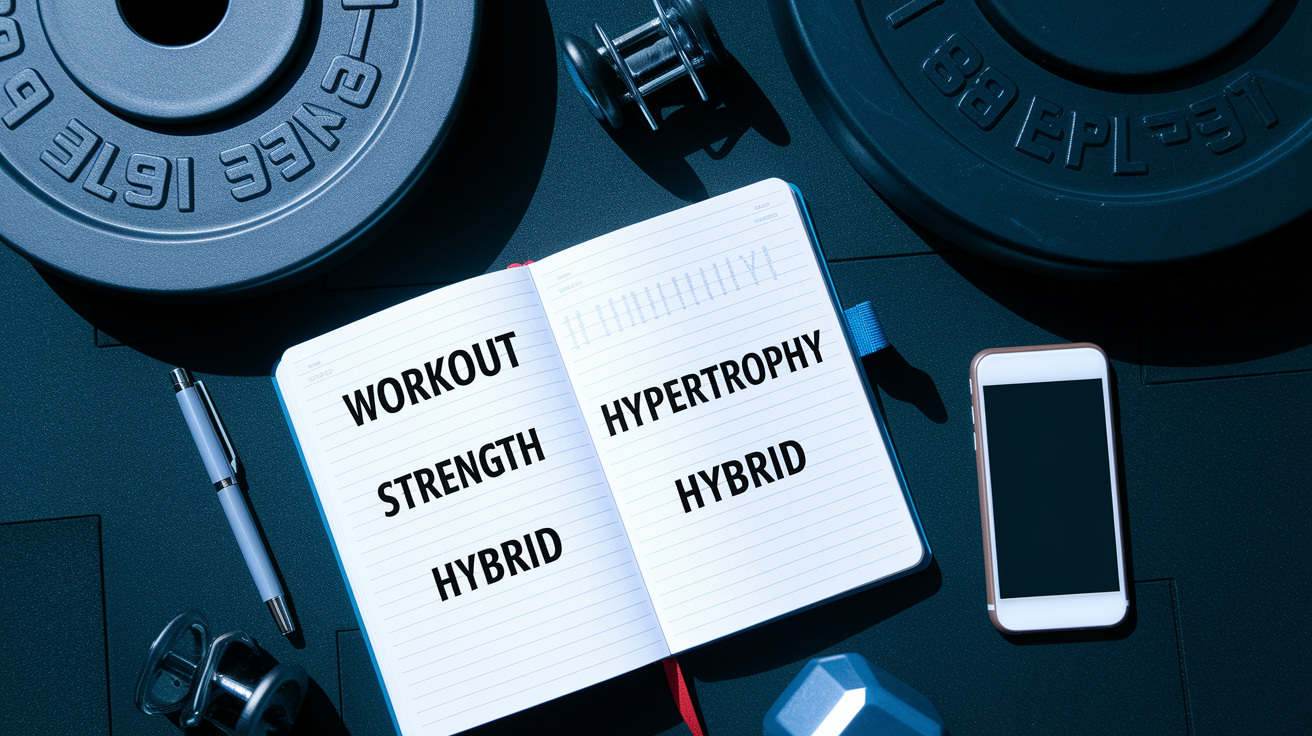
Strength-focused sample (3 full-body days per week):
Barbell back squat: 5 sets of 3 reps at 85–90% estimated 1RM, rest 4 minutes. Barbell bench press: 4 sets of 5 reps at 80–85% estimated 1RM, rest 3 minutes. Barbell row: 4 sets of 5 reps at 80% estimated 1RM, rest 3 minutes. This template prioritizes neural adaptations and prepares you to lift heavier weights over the next 8–12 weeks.
Hypertrophy-focused sample (4 days per week, upper/lower split):
Upper day: Dumbbell bench press: 4 sets of 10 reps, rest 90 seconds. Seated cable row: 4 sets of 10 reps, rest 90 seconds. Dumbbell shoulder press: 3 sets of 12 reps, rest 60 seconds. Barbell curl and triceps pushdown superset: 3 sets of 12 reps each, rest 60 seconds.
Lower day: Leg press: 4 sets of 12 reps, rest 90 seconds. Romanian deadlift: 3 sets of 10 reps, rest 90 seconds. Leg curl: 3 sets of 15 reps, rest 60 seconds. This template accumulates higher volume per muscle and emphasizes metabolic stress for size.
Hybrid balanced sample (3 days per week, full-body):
Day A: Trap-bar deadlift: 5 sets of 3 reps, rest 4 minutes. Incline dumbbell press: 3 sets of 10 reps, rest 90 seconds. Lat pulldown: 3 sets of 12 reps, rest 90 seconds.
Day B: Front squat: 4 sets of 5 reps, rest 3 minutes. Dumbbell row: 3 sets of 10 reps, rest 90 seconds. Dumbbell Romanian deadlift: 3 sets of 12 reps, rest 90 seconds.
Day C: Barbell bench press: 4 sets of 5 reps, rest 3 minutes. Bulgarian split squat: 3 sets of 10 reps per leg, rest 90 seconds. Face pull: 3 sets of 15 reps, rest 60 seconds.
This template gives you one heavy strength lift per session followed by moderate-rep hypertrophy work, balancing both goals across the week.
Common Myths and Misunderstandings About Beginner Rep Ranges

One common myth is that only 8–12 reps build muscle. Research shows hypertrophy occurs across a wide range of rep counts, from as low as 5 reps to as high as 20 or 30, when sets are taken close to failure and total weekly volume is sufficient. The 8–12 range is practical and efficient, not magical. You can build muscle with heavier sets of 5 or lighter sets of 15 if you work hard enough.
Another myth is that low-rep heavy training can’t build muscle. In reality, sets of 3–5 reps at high intensity do produce hypertrophy, especially in beginners. The main limitation is that very low reps require more total sets to match the volume of moderate-rep training, and they create more joint stress and CNS fatigue. So while low-rep work builds muscle, it’s often less efficient for pure size compared to moderate reps.
Some beginners believe they must train every set to absolute failure to see results. Studies show that stopping 2–3 reps short of failure still produces excellent strength and hypertrophy gains, and it preserves your technique and energy for subsequent sets. Training to failure occasionally can be useful, but it’s not required and often increases injury risk when done too frequently.
A final misunderstanding is that high reps are only for endurance or fat loss. High-rep training (15–20+ reps) does improve muscular endurance, but it also builds muscle when sets are taken near failure. The main practical issue is that very high reps on complex lifts (like squats) can turn into a cardiovascular challenge before you reach muscular failure, making them less efficient for hypertrophy. High reps work best on isolation movements or machines where you can safely push close to failure without technique breakdown.
Safety, Recovery, and Technique Considerations When Selecting Rep Ranges

Heavy low-rep sets (1–5 reps) increase stress on your joints, connective tissue, and spine because the absolute load is high. Beginners should use this rep range only after mastering technique with lighter loads, and should avoid training to absolute failure on complex lifts like squats and deadlifts. High-rep sets (15+) on technical lifts create a different risk. As fatigue accumulates, your form can deteriorate, increasing the chance of a tweak or strain. Match your rep range to your skill level and the complexity of the movement.
Beginners typically see measurable strength improvements within 2 to 12 weeks, driven mostly by neural adaptations. Muscle size changes take longer, usually 6 to 12 weeks before you notice visible growth. This timeline means you should prioritize consistency and technique over chasing quick results. Rest periods matter for recovery: 1.5 to 2 minutes for moderate-rep isolation work, 3 to 5 minutes for heavy compound lifts. Adequate rest between sets lets you maintain quality and hit your target reps and load.
Five key safety rules for all rep ranges:
- Master technique with bodyweight or light loads before adding external weight. If you can’t complete 10 bodyweight squats with good form, don’t add a barbell yet.
- Control the speed of every rep, especially the lowering (eccentric) phase, to reduce joint stress and build motor control.
- Warm up with 1–2 sets at 50–60% of your working weight before heavy sets to prepare joints and nervous system.
- Plan a deload week (reducing volume or intensity by roughly 40–50%) every 4 to 6 weeks to allow full recovery and prevent overuse injuries.
- Stop each set 2–3 reps before absolute failure on compound lifts. You can push closer to failure on machines and isolation movements where the risk is lower.
Final Words
Pick 1–5 reps for strength (4–6 sets, 3–5 min rest) and 6–12 reps for hypertrophy (3–5 sets, 60–90s rest). The post covered sets, weekly volume, exercise choices, progression tips, sample workouts, and safety basics.
Start with technique, track weekly sets, progress weight or reps slowly, and mix ranges when you want both.
The ideal rep ranges for beginner strength vs hypertrophy explained here give you a clear place to start—pick a focus, use the templates, and add a bit each week. You’ve got this.
FAQ
Q: What is the best rep range for strength vs hypertrophy?
A: The best rep range for strength vs hypertrophy is: strength—1–5 reps, 4–6 sets, 3–5 minutes rest; hypertrophy—6–12 reps (often 8–12), 3–5 sets, 60–90 seconds rest.
Q: What is the 3-3-3 rule gym?
A: The 3-3-3 rule in the gym usually means three sets of three reps, a simple strength-focused scheme used to lift heavy with longer rests and steady, small weight increases to build technique and neural strength.
Q: Should beginners start with strength or hypertrophy?
A: Beginners should start with a strength-focused base while keeping some moderate rep accessory work for size—build technique and confidence for 4–8 weeks, then shift balance based on goals and preference.
Q: What is the 5-3-1 rule in gym?
A: The 5-3-1 rule in the gym is a four-week strength cycle: week 1 uses heavier sets of five, week 2 sets of three, week 3 a top single (1+), and week 4 is a deload.