

Think the calories on your meal-prep labels are close? Guessing portions usually leaves you way off.
This guide will show a simple, repeatable method to get exact calories into each container, no guesswork.
You’ll learn why weighing cooked food matters, how to convert ingredient calories to calories-per-gram, how to split totals for uneven portions, and which apps speed the math.
Follow these steps and your boxes will match your log, so you can hit goals without second-guessing.
How to Calculate Total Recipe Calories and Divide Them Into Containers (Step-by-Step)

Grab every ingredient you’re using. Weigh or measure each one before or after cooking, whichever matches your calorie database. Most sources give you either raw or cooked values, not both. Pick one and stick with it.
Weighing cooked food usually makes more sense for meal prep. Water evaporates out of meat, rice soaks it up, sauces thicken. If you weigh raw but log cooked calories, your numbers won’t line up with what’s actually in your container. Weigh the whole batch after cooking, split by container count, and you’ve got real portion sizes.
Here’s how it works:
- Cook everything and let it cool a bit so steam doesn’t mess with the scale.
- Weigh the full batch in grams on a digital kitchen scale.
- Pull calorie data per 100 grams for each ingredient from something reliable (USDA FoodData Central works, or MyFitnessPal if you double-check entries).
- Take each ingredient’s cooked weight in grams, multiply by its calories per 100g, then divide by 100.
- Add all those ingredient totals together for your recipe’s full calorie count.
- Divide total calories by however many containers you’re filling.
- If your portions aren’t identical, divide total calories by total weight in grams to get calories per gram, then multiply each container’s weight by that number.
- Label the containers and store them.
Example: You make a batch that’s 1,200 calories and weighs 1,200 grams cooked. You’re splitting it into four containers. Simple math gives you 300 calories each (1,200 ÷ 4 = 300). But if one container weighs 320 grams, find calories per gram first: 1,200 calories ÷ 1,200 grams = 1 calorie per gram. That 320-gram container holds 320 calories.
How to Weigh Ingredients and Cooked Meals for Accurate Calorie Tracking

Raw food changes weight when you cook it. Chicken breast drops about 25 percent from water loss when you grill it. Rice nearly triples once it absorbs water. Log 100 grams of raw chicken at 120 calories per 100g but serve 75 grams cooked, and your count’s off unless you adjust. Weighing after cooking gives you the real portion going into your box.
A digital kitchen scale is the only tool that gets you gram-level accuracy. Measuring cups work okay for liquids and some dry stuff, but they can’t handle air pockets, packing differences, or weird shapes like chicken thighs or broccoli. A scale cuts out guesswork and takes maybe ten seconds per ingredient.
Weigh these to stay accurate:
- The full cooked batch before you split it
- High-calorie stuff like oils, butter, cheese, nuts
- Sauces, dressings, marinades that stick to the food
- Each filled container if you want exact per-container counts
- Any toppings or sides you’re adding separately
Handling Uneven Portions and Mixed Meals
Not every scoop of chili or stir-fry has the same protein-to-veggie-to-sauce ratio. One container might get more chicken, another more rice. Dividing total calories by container count assumes perfect distribution. That’s fine for smoothies or fully mixed soups. Falls apart for chunky or layered meals.
Best fix? Calculate calories per gram. Weigh the whole cooked batch, divide total calories by total grams, and you’ve got a universal number. Then weigh each container as you fill it. Multiply container weight by calories per gram, and you know exactly what’s in that specific portion. Handles uneven scooping and ingredient clumping without sorting every piece of food manually.
Example: A curry hits 2,000 calories and weighs 2,500 grams cooked. Calories per gram = 2,000 ÷ 2,500 = 0.8. Container A weighs 480 grams, so it’s 480 × 0.8 = 384 calories. Container B weighs 520 grams and holds 520 × 0.8 = 416 calories. That small weight difference is a 32-calorie gap, which matters if you’re tracking a tight deficit or hitting specific macros.
Using Apps and Digital Tools to Speed Up Calorie Calculation

Calorie apps store ingredient libraries, let you scan barcodes, and auto-calculate recipe totals. Enter each ingredient once, set serving count, and the app divides calories and macros for you. Most let you log by grams instead of vague serving sizes, which helps when you’re weighing food.
Batch recipe features save time. Duplicate a saved recipe, tweak ingredient weights for a new batch, and you get updated totals instantly. Some sync across devices so you can build recipes on a computer and log meals on your phone. If you prep the same rotation every week, you only calculate each recipe once.
Features worth using:
- Barcode scanning for packaged stuff
- Custom recipe builder with gram-based entry
- Automatic portion splits by servings or container count
- Recipe duplication and scaling for different batch sizes
Macro Tracking Tips for Meal Prep

Calories show total energy. Macros show how much protein, carbs, and fat you’re eating. Each macro has a different calorie value per gram: protein and carbs both give you 4 calories per gram, fat gives 9. If you know total grams of each macro in your recipe, you can split them the same way you split calories.
Add up protein, carbs, and fat grams from every ingredient using database values or labels. Divide each macro total by container count. If you’re using the calories-per-gram method for uneven portions, you can also calculate protein per gram, carbs per gram, fat per gram, then multiply by each container’s weight. Gives you precise macro counts that match what’s actually in each box.
| Macro | Total per Recipe (g) | Per Container (5 containers) |
|---|---|---|
| Protein | 250 g | 50 g |
| Carbs | 300 g | 60 g |
| Fat | 100 g | 20 g |
Real Examples: Calorie Calculations for Common Meal Prep Recipes
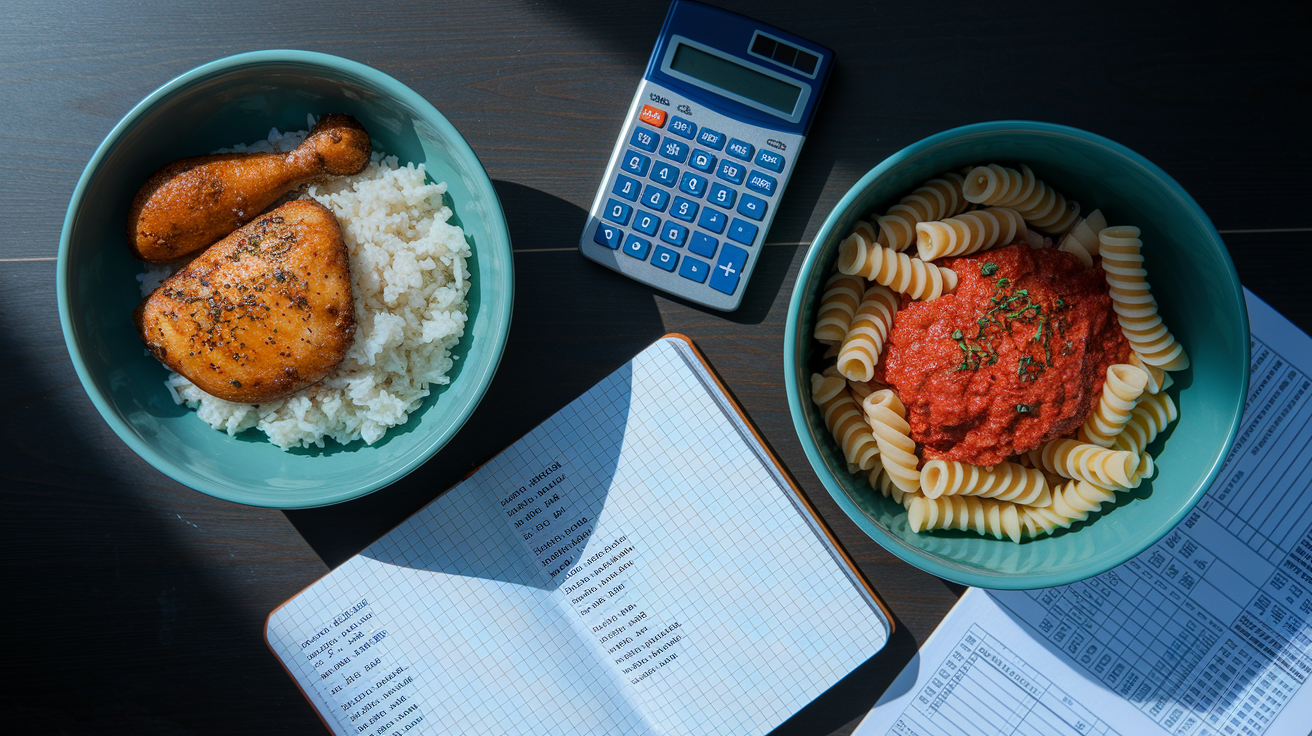
Chicken and Rice Bowl
You cook 600 grams of chicken breast, 400 grams of white rice, 300 grams of steamed broccoli. Chicken at 165 calories per 100g gives you 990 calories. Rice at 130 per 100g gives 520. Broccoli at 35 per 100g gives 105. Drizzle 2 tablespoons of olive oil over the batch, adding 240 calories.
- Total calories = 990 + 520 + 105 + 240 = 1,855
- Total cooked weight = 600 + 400 + 300 + 28 (oil) = 1,328 grams
- Split into 5 containers: 1,855 ÷ 5 = 371 calories each
- Calories per gram = 1,855 ÷ 1,328 = 1.4 for weight-based portioning
Pasta with Marinara and Ground Turkey
You prep 400 grams of cooked penne, 500 grams of cooked ground turkey, 300 grams of marinara. Pasta at 131 per 100g gives 524 calories. Turkey at 150 per 100g gives 750. Sauce at 50 per 100g gives 150.
- Total calories = 524 + 750 + 150 = 1,424
- Total weight = 400 + 500 + 300 = 1,200 grams
- Split into 4 containers: 1,424 ÷ 4 = 356 calories each
- Calories per gram = 1,424 ÷ 1,200 = 1.19
Vegetable Stir-Fry with Tofu
You stir-fry 400 grams of firm tofu, 200 grams of bell peppers, 200 grams of snap peas, 100 grams of onions. Use 1 tablespoon of sesame oil and 2 tablespoons of soy sauce. Tofu at 76 per 100g gives 304 calories. Peppers at 20 per 100g give 40. Snap peas at 42 per 100g give 84. Onions at 40 per 100g give 40. Sesame oil adds 120, soy sauce adds 20.
- Total calories = 304 + 40 + 84 + 40 + 120 + 20 = 608
- Total weight = 400 + 200 + 200 + 100 + 14 (oil) + 30 (soy sauce) = 944 grams
- Split into 3 containers: 608 ÷ 3 = 203 calories each
- Calories per gram = 608 ÷ 944 = 0.64
Final Words
In the action, you followed step-by-step calorie math, learned why weighing cooked food gives better accuracy, handled uneven portions, used apps to speed the work, and divided macros so each container is predictable.
Do this tonight: weigh a cooked batch, total the calories, and divide by number of containers. Try the 1,200 total calories divided by four example (300 per container).
Now you can make portions you can trust.
This simple method shows how to calculate calories for meal prep containers. Keep it simple and keep going. You’re building a habit that works.
FAQ
Q: What is the 494 rule for calories? / What is the 9 4 4 rule for calories?
A: The 494 (or 9-4-4) rule for calories is a macronutrient guide: fat gives 9 calories per gram, protein 4 calories per gram, and carbs 4 calories per gram.
Q: How to figure out portions for meal prep?
A: To figure out portions for meal prep, weigh the cooked batch, divide total grams by the number of containers, then portion each container by weight or by your target calories.
Q: How to calculate calories on food packets?
A: To calculate calories on food packets, use the label’s serving size and calories per serving (or per 100g), then scale by the grams you actually eat to get calories consumed.