

Think sitting all day is harmless? Think again.
If your neck, shoulders, or hips feel tight after a couple hours at your desk, you can fix it fast.
This post gives a five-minute, no-equipment routine you can do between meetings to restore blood flow and loosen tight spots across your neck, shoulders, back, and hips.
It’s discreet, works in whatever you’re wearing, and was made for busy beginners who want quick relief.
Try it today and feel less stiff before your next break.
Quick-Start Desk Routine for Fast Stiffness Relief

Stiffness creeps in when your muscles lock into the same position for too long. These quick exercises restore blood flow and release tight spots across your neck, shoulders, back, and hips. Takes about five minutes, needs zero equipment, and works in whatever you’re wearing. Run through it between meetings or whenever things start feeling tight.
Triceps stretch – Raise one arm overhead, bend at the elbow so your hand reaches toward the opposite shoulder. Use your other hand to gently pull that elbow toward your head. Hold 10 to 30 seconds, switch sides.
Overhead reach – Extend one arm straight up and lean toward the opposite side. You’ll feel the stretch along your ribs and shoulder. Hold 10 to 30 seconds, then switch.
Chest opener – Clasp both hands behind your lower back, push your chest forward, lift your chin slightly. Hold 10 to 30 seconds.
Forward upper-back stretch – Clasp your hands in front at chest height, drop your head between your arms, push your hands forward. Hold 10 to 30 seconds.
Shoulder shrugs – Lift both shoulders toward your ears, then drop them. Repeat 10 times, slow and controlled.
Neck rolls – Relax your shoulders and slowly roll your head forward, then gently to one side. Hold a few seconds. Return to center and repeat to the other side. Do 3 full cycles each direction.
Breathe normally through everything. Exhale as you lean into each stretch to get more range without straining. If you feel sharp pain, stop right there and come back to neutral.
Neck and Shoulder Mobility Refinements for Desk Workers

Forward head posture and rounded shoulders are what happens when you spend hours staring at screens. Your neck drifts forward, tiny stabilizers at the base of your skull get overloaded, and you end up with tension headaches and chronic upper-body tightness. These movements strengthen mid-back muscles, realign your head over your shoulders, and reduce strain that simple stretches don’t touch.
These work best when you pair them with the quick-start routine. The chin tuck retrains deep cervical flexors. The scapular squeeze wakes up dormant mid-back stabilizers. The controlled neck rotation improves range without compensating through the upper traps. Together they offer lasting relief from tension headaches and cut down on neck discomfort during long work sessions.
Chin tucks – Sit tall and gently pull your chin straight back, like you’re making a double chin, without tilting your head up or down. Hold each tuck 2 to 3 seconds and repeat 8 to 10 times. This recruits deep neck flexors that support healthy alignment.
Neck rotation (controlled range) – Keep your shoulders still and slowly turn your head to look over one shoulder. Pause at comfortable end range for 2 to 3 seconds. Return to center and repeat to the other side. Perform 5 slow, deliberate rotations per side.
Scapular squeezes – Sit upright with arms relaxed at your sides. Squeeze your shoulder blades together, like you’re pinching a pencil between them. Hold 2 to 3 seconds. Release and repeat 10 to 12 times. This counters the forward-shoulder slouch.
Upper trapezius stretch with posture cue – Anchor one hand under your chair or place it on your thigh. Gently tilt your head toward the opposite shoulder until you feel a light stretch along the side of your neck. Hold 10 to 15 seconds, switch sides, repeat 1 to 2 times per side. Keep your spine tall throughout to isolate the upper trap.
Back-Focused Technique Enhancements for Thoracic and Lumbar Mobility
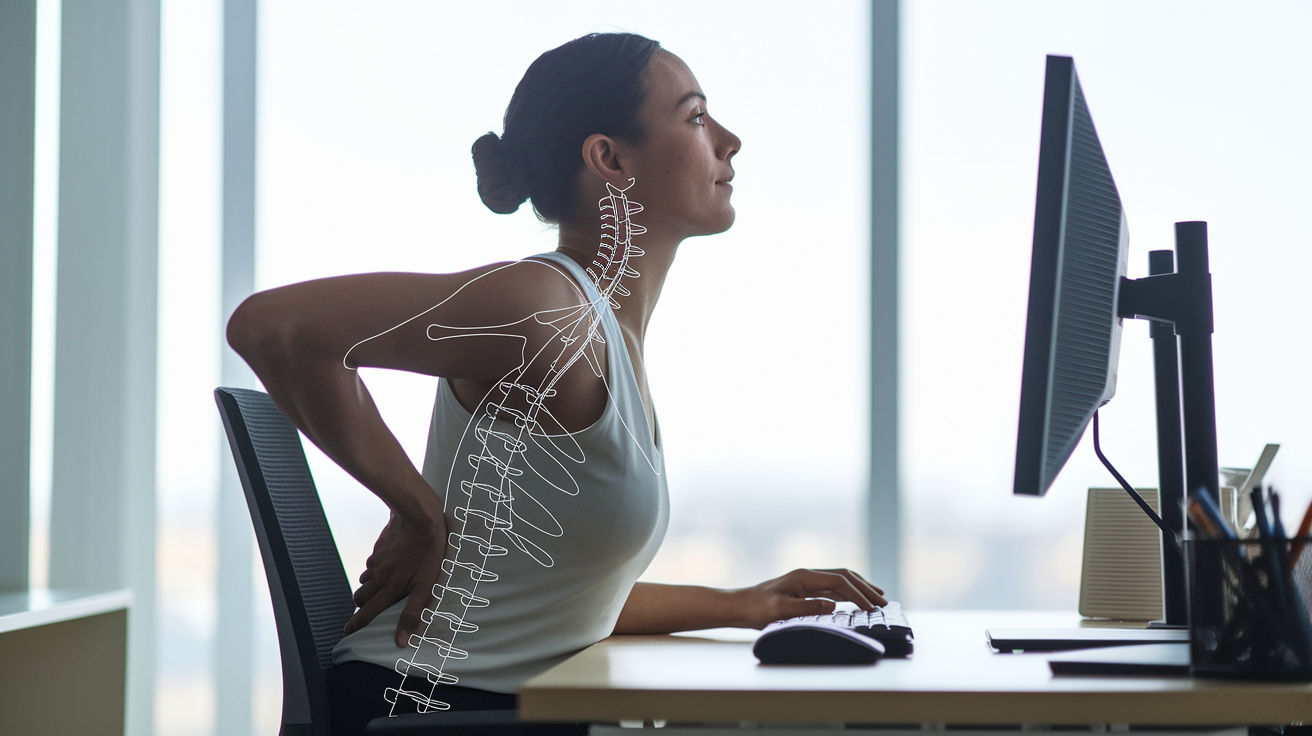
Thoracic immobility is a hidden culprit behind low-back pain and shoulder discomfort. When your mid-back loses extension and rotation capacity, neighboring regions compensate by bending or twisting beyond their ideal range. Office workers often lock into a neutral-to-flexed thoracic posture for hours, which reduces rib mobility, weakens spinal extensors, and creates stiff spots that radiate discomfort downward into the lower back and upward into the neck.
Controlled thoracic extension drills and cat-cow cycles build gentle motion in the middle and lower spine. Thoracic extension over the back of your chair lets gravity assist the stretch while you actively engage spinal extensors on the return, strengthening as you mobilize. Seated cat-cow pairs an inhale with a gentle arch (lifting your chest and looking slightly up) and an exhale with rounding your spine (tucking your chin and drawing your navel in). Creates fluid motion through 8 to 12 cycles. These dynamic stretches reset stiffness patterns faster than static holds alone.
For the seated spinal twist, sit tall with your hips square to the front, place one hand on the opposite knee, and rotate your torso toward that side while keeping both sit bones grounded. Hold 15 to 30 seconds and repeat on the other side. Rotate from your mid-back, not your neck, to isolate thoracic motion.
When performing the hamstring stretch, extend only one leg at a time and prop your foot on a second chair or low surface. Hinge forward from your hips (not your low back) and hold 10 to 30 seconds per side. Extending both legs at once can force your lumbar spine into unsafe flexion, so single-leg variations prevent back strain while still releasing tight hamstrings.
Hip and Glute Desk Movements With Progressions for Long Sitting

Prolonged sitting shortens your hip flexors, underactivates your glutes, and reduces hip internal and external rotation. Creates a feedback loop that increases low-back load and limits comfortable movement when you stand or walk. Progressive hip mobility exercises restore range, wake up dormant glute fibers, and counterbalance the flexed-hip position that defines desk work. These go deeper than the basic knee hug, offering targeted angles and activation cues that address specific hip stiffness patterns.
All of these movements are discreet enough for business attire. You can perform them between calls or during short breaks without drawing attention. The seated figure-four stretch opens your hip external rotators and glutes while maintaining a stable, upright spine. The standing quad stretch (lightly holding your desk for balance) lengthens hip flexors without requiring you to lie down or use props.
| Exercise | Target Area | Hold/Reps | Notes |
|---|---|---|---|
| Hip flexion knee-hug | Hip flexors, lower back | 10 to 30 seconds per side | Hug one knee to chest while seated; alternate legs. |
| Seated figure-four | Glutes, hip external rotators | 15 to 30 seconds per side | Cross one ankle over opposite knee, sit tall, lean forward slightly. |
| Seated side stretch | Lateral hip, obliques | 20 seconds per side | Reach overhead and lean to one side; keep hips anchored. |
| Standing quad stretch | Hip flexors, quadriceps | 15 to 30 seconds per side | Hold desk for balance; pull one heel toward glute. |
| Light glute squeeze activation | Glutes | 10 to 15 reps | Seated or standing, squeeze glutes for 2 to 3 seconds each rep. |
Wrist, Forearm, Ankle, and Circulation-Boosting Micro‑Movements

Repetitive typing keeps your wrists in sustained extension or flexion, loading the small tendons and muscles of the forearm. Leads to soreness, tingling, or fatigue by mid-afternoon. Static ankle and calf positions reduce venous return from your lower legs, contributing to swelling, heaviness, and reduced alertness. These overlooked areas respond quickly to short, frequent movement breaks that take less than a minute.
Micro-movements lasting 30 to 60 seconds counter reduced circulation by contracting and relaxing muscles that act as pumps, pushing blood and lymph back toward your heart. Seated calf raises and ankle circles restore fluid motion in your lower legs. Wrist and forearm stretches release tension built up from sustained keyboard and mouse use. Marching in place (seated or standing) briefly elevates your heart rate and increases whole-body circulation, making it an effective warm-up before a longer stretch routine or a quick reset during back-to-back meetings.
Wrist flexor stretch – Extend one arm forward, palm up. Use your other hand to gently pull your fingers back toward your body. Hold 15 to 20 seconds, then switch.
Wrist extensor stretch – Extend one arm forward, palm down. Gently pull your fingers down and back. Hold 15 to 20 seconds, then switch.
Forearm rotation – Hold one arm out with elbow bent 90 degrees. Slowly rotate your palm up, then palm down, 8 to 10 times per side.
Ankle circles – Lift one foot slightly off the floor and draw slow circles with your toes, 5 in each direction. Switch feet.
Seated calf raises – Press through the balls of your feet to lift your heels off the floor, hold 1 to 2 seconds, and lower. Repeat 10 to 15 times.
Marching in place (seated or standing) – Lift your knees alternately for 30 to 60 seconds at a comfortable pace.
A Simple 5-Minute Desk Routine for Busy Beginners

This timed five-minute circuit condenses essential movements into a follow-along sequence you can repeat between meetings, after lunch, or whenever stiffness appears. The routine pairs dynamic movements with brief static holds, balancing quick circulation boosts and targeted stretches across your neck, shoulders, back, and hips. You don’t need to remember complex order or counts. Just follow the timings below and move through each step at a steady, controlled pace.
5‑Minute Guided Sequence
The flow keeps total time under control while hitting every major stiffness zone, so you return to work feeling looser and more alert without losing momentum on your schedule.
Chin tucks – 30 seconds. Sit tall and perform slow, controlled chin retractions, holding each for 2 to 3 seconds before releasing.
Shoulder rolls – 60 seconds. Roll your shoulders forward for 30 seconds (about 10 slow rolls), then backward for 30 seconds.
Seated cat-cow – 60 seconds. Inhale as you arch your spine and lift your chest, exhale as you round your back and tuck your chin. Repeat continuously for the full minute.
Seated figure-four (hip stretch) – 30 seconds per side. Cross one ankle over the opposite knee, sit tall, and lean gently forward. Switch legs halfway.
Neck tilts (lateral stretch) – 30 seconds total. Tilt your head toward one shoulder, hold 10 to 15 seconds, return to center, and repeat on the other side.
Standing or seated marching – 30 seconds. Lift your knees alternately to raise your heart rate and finish with light circulation.
Frequency, Safety, and Ergonomics for Reducing Desk Stiffness
Aim to change position or take a micro-break every 30 to 60 minutes during your workday, even if it’s just standing for a phone call or walking to refill water. A full 5-minute desk routine performed 2 to 3 times daily provides enough movement stimulus to counteract the stiffness that builds during long sitting sessions. More frequent short bursts (60 to 90 seconds of shoulder rolls or neck stretches every hour) can supplement longer sessions and keep discomfort from accumulating between scheduled breaks.
Always exhale as you lean into a stretch to help muscles relax and increase comfortable range. Gentle pulling or mild tension is normal. But sharp, sudden, or radiating pain is a warning to stop and return to a neutral position. If pain persists, worsens, or appears without an obvious cause, consult a health professional. Never force a stretch beyond your current comfortable limit, and avoid bouncing or jerky movements that can strain cold tissues.
Ergonomic setup complements these stretches by reducing the postural load that creates tightness in the first place. Position your monitor so the top of the screen sits at or slightly below eye level, keeping your neck in a neutral, forward-facing alignment. Adjust your chair height so your feet rest flat on the floor and your knees align at roughly 90 degrees. Keep your keyboard and mouse close enough that your elbows stay near your sides and your wrists remain in a neutral (not bent up or down) position. A lumbar support cushion or rolled towel at your lower back helps maintain the natural curve of your spine and reduces low-back fatigue.
Evidence Snapshot
Peer-reviewed studies and systematic reviews published between 2022 and 2025 consistently show that workplace stretching and exercise interventions reduce musculoskeletal symptoms, improve perceived comfort, and support better posture among office workers. Short, frequent movement breaks appear as effective as longer sessions when performed regularly throughout the workday.
Building a Sustainable Desk-Exercise Habit
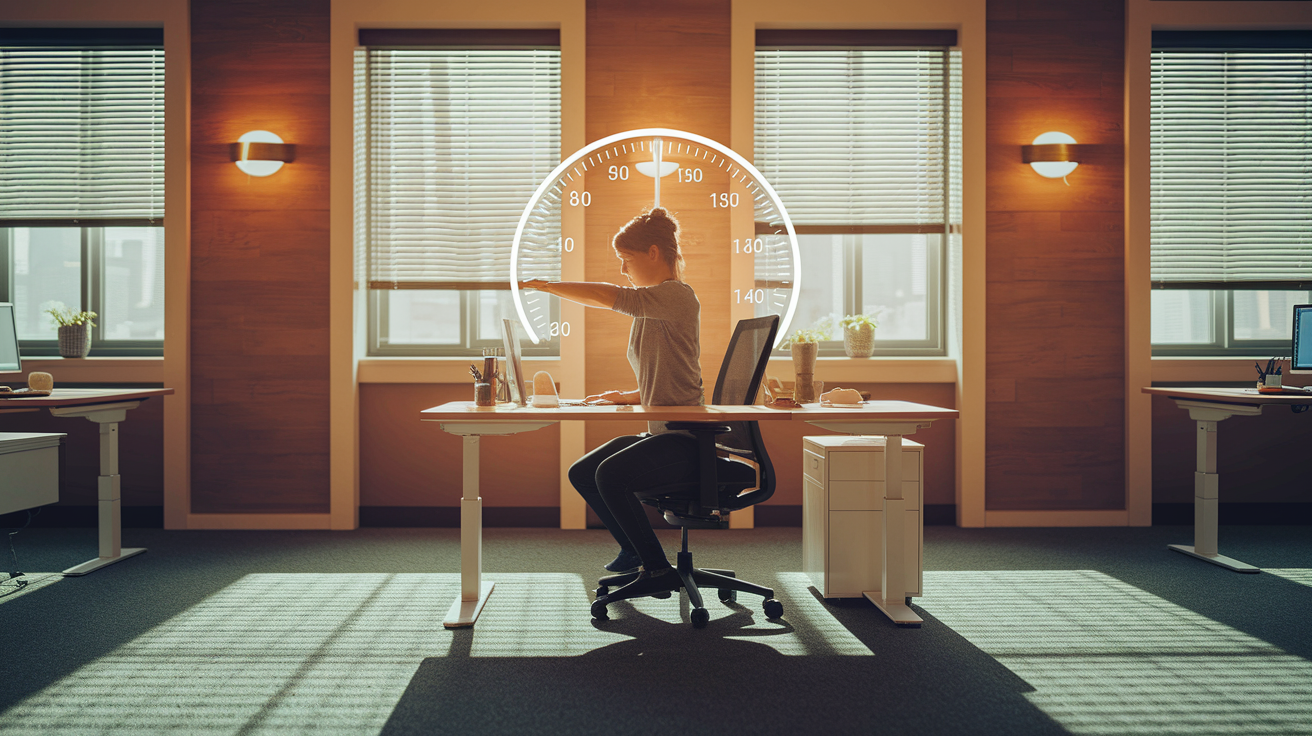
Habit formation depends on pairing new behaviors with existing environmental cues. Link your desk stretches to events that already happen multiple times per day. Set a recurring phone timer for every 60 or 90 minutes, use calendar blocks between meetings as stretch reminders, or anchor a quick shoulder-roll set to the moment you finish reading an email batch. These triggers reduce decision fatigue and turn movement into an automatic response rather than a task you have to remember.
Realistic goals for busy beginners focus on consistency over duration. Performing a 60-second stretch set twice a day beats skipping an ambitious 20-minute plan. As the movements become easier and feel automatic, add 5 to 10 seconds to your hold times weekly or insert one additional exercise into your routine. Progress happens through repetition and small upgrades, not sudden jumps in intensity or complexity.
Timer reminders – Set recurring alerts on your phone or computer every 30 to 60 minutes to prompt a quick stretch or posture check.
Pairing stretches with calls – Stand during phone conversations and perform gentle calf raises, hip circles, or overhead reaches while talking.
Adding 5 to 10 seconds weekly – Once a stretch feels comfortable at 10 seconds, extend it to 15, then 20, progressing gradually without forcing new range.
Final Words
Start by doing the five-minute guided sequence after your next meeting—it’s quick, discreet, and eases stiffness fast.
This post gave a no-equipment quick-start, neck and shoulder refinements, thoracic and lumbar drills, hip/glute progressions, wrist/ankle micro-moves, and habit tips. Hold static stretches 10–30 seconds, do neck rolls and shrugs as listed, and use short dynamic cycles when you can.
Try the routine today; exhale into each stretch and stop if you feel sharp pain.
These desk-friendly exercises for busy beginners to reduce stiffness slip into your day, and with small repeatable steps you’ll feel better soon.
FAQ
Q: What can reduce stiffness at a desk job?
A: Reducing stiffness at a desk job means moving often, doing short desk stretches, and fixing ergonomics like screen height and lumbar support. Aim for a 5-10 minute routine each hour or micro-breaks every 30-60 minutes.
Q: What is the 3-3-3 rule for workout?
A: The 3-3-3 rule for workouts is a simple short structure: three sets, three reps or three exercises across three rounds, meant to keep sessions brief, focused, and easy to repeat during busy days.
Q: What exercises decrease stiffness and how can I exercise while sitting at my desk?
A: Exercises that decrease stiffness and ways to exercise while sitting at your desk include seated stretches (neck rolls, shoulder shrugs, chest opener), seated figure-four hip stretch, ankle circles, and brief calf raises, hold 10-30 seconds or do 10 reps.