

Who says you need an hour at the gym to get fitter?
If you’re time-poor, this beginner stair workout gives real results in five to fifteen minutes.
No membership, no gear.
Just a flight of steps, a timer, and a plan you can follow between meetings or while dinner heats.
This post hands you simple, safe routines (5, 10, 15 minutes), a quick warm-up, and tiny progressions so you build cardio and leg strength without stealing your day.
Fast Beginner Stair Routine That Fits a Time‑Poor Schedule

Stairs become your workout station in under 10 minutes. No gym membership, no equipment, no hour-long commitment. Just one flight and five minutes, and you’ve got cardio plus leg strength in a single package.
Short routines work because they stack quick bursts of effort with minimal rest. The plan’s dead simple: move for 20 to 60 seconds, rest for 10 to 30, repeat. This article gives you three plug-and-play routines at 5, 10, and 15 minutes. Warm-up and cool-down details come later. Right now, here’s the tightest option that fits the busiest day.
0:00–0:30 — March in place or take slow steps up and down to wake up your legs
0:30–4:00 — 4 rounds: 30 seconds of alternating step-ups (right foot up, left foot up, right down, left down) + 15 seconds standing rest
4:00–5:00 — 45 to 60 seconds of slow calf raises on a step edge
Total time — 5 minutes start to finish
Best slot — Before breakfast, lunch break, or right after work while dinner heats up
Three sessions per week if you’re new. That gives your legs recovery time while you build the habit. If five minutes feels easy after two weeks, toss in another round of step-ups or stretch the calf raises to 90 seconds. You can jump to the 10-minute routine once your breathing stays controlled and your legs don’t complain the next morning.
Key Benefits of a Beginner Stair Workout Routine

Stair climbing torches roughly 5 to 10 calories per minute depending on your weight and how fast you move. A 10-minute session burns 50 to 100 calories, which stacks up over a week. Beyond calorie burn, stairs push your heart rate into cardio territory without the pounding of running. Your breathing deepens, your heart works harder, your aerobic system improves with every climb.
Stairs build strength in your glutes, quads, hamstrings, and calves every time you step up. The lowering phase on each step challenges your muscles under control, improving stability and balance. You’re lifting your body weight repeatedly, so stair work counts as resistance training for your lower body. It’s gentler than running, making it safer if your knees or hips feel touchy. Climbing also improves ankle and hip mobility as you bend and extend through a full range with every step.
| Benefit | What It Helps With |
|---|---|
| Cardio improvement | Raises heart rate, strengthens heart and lungs, builds endurance for daily tasks |
| Lower-body strength | Targets glutes, quads, hamstrings, and calves through repeated stepping and controlled lowering |
| Calorie burn | Burns 5–10 kcal/min; 10-minute session uses ~50–100 kcal depending on intensity and body weight |
| Mobility and balance | Improves hip, knee, and ankle range of motion; enhances stability and movement control |
Equipment and Preparation for a Beginner Stair Routine

You need three things: safe stairs, supportive shoes, and a timer. Any indoor or outdoor staircase works as long as the steps are dry, well-lit, and clutter-free. A stopwatch on your phone or a kitchen timer keeps your intervals honest. Athletic shoes with grip reduce the risk of slipping and protect your ankles during quick direction changes.
Indoor stairs give you climate control and consistent footing. Outdoor stadium stairs or park steps give you fresh air and often more vertical height per climb. Step height matters for beginners. Standard home stairs run 7 to 8 inches tall, which suits most people. Taller steps, like those in older buildings or stadiums, crank up the challenge and may need a slower pace until your legs adjust.
Choose a safe spot — Test the surface for grip, check lighting, clear any obstacles like bags or shoes.
Wear proper shoes — Firm sole, good arch support, snug heel to prevent sliding during fast intervals.
Prep your timer — Set up interval alerts on your phone or use a visible clock so you’re not guessing when to start and stop.
Warm-Up Essentials Before a Quick Stair Workout

A short warm-up cuts injury risk and preps your joints for the repeated bending and lifting that stair work demands. Three to five minutes of light movement raises your core temperature, lubricates your knees and ankles, signals your nervous system that work’s coming. Skipping it increases the chance of a pulled muscle or a tweaked knee, especially on the first few climbs when your legs are still cold.
Marching in place — 60 to 90 seconds at a comfortable pace; lift your knees to hip height, swing your arms naturally
Leg swings — 30 seconds per side; hold a wall or railing and swing one leg forward and back in a controlled arc
Hip circles — 30 seconds total; stand on one leg and draw small circles with the opposite knee
Ankle circles — 30 seconds total; lift one foot and rotate your ankle slowly in both directions
This warm-up takes less time than scrolling through a few posts, and it cuts your risk of a nagging ache that sidelines your next session. Your legs feel looser, your breathing settles faster, the first set of step-ups won’t hit like a sudden shock.
Step-by-Step Beginner Stair Exercises
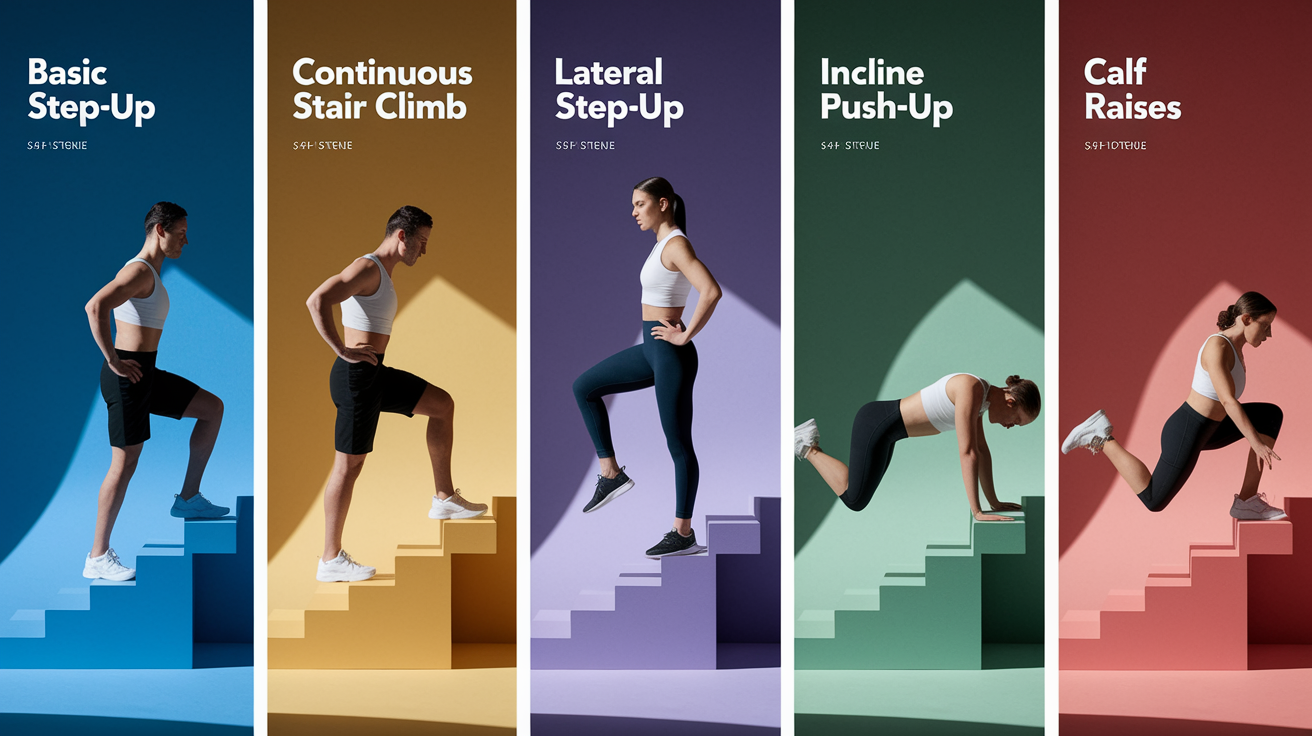
These five exercises form the base of every beginner stair routine. Get the basic movement pattern down first, then adjust speed or add rounds as your fitness improves.
Basic Step-Up
Put your right foot fully on the step in front of you, heel to toe. Push through your right heel and lift your body until your right leg’s straight, then bring your left foot up to meet it. Step back down with your left foot first, then your right, repeat. Go for 8 to 12 reps per leg at a controlled pace. Chest up, don’t lean forward or you shift work away from your glutes and into your lower back.
Continuous Stair Climb
Walk up a flight at a steady, sustainable pace for 45 to 60 seconds. Even breathing, rhythm you can hold without gasping. At the top, walk back down slowly to reset, start the next interval. Pure cardio with a strength bonus every time you push off a step.
Lateral Step-Up
Stand sideways next to a step. Place your right foot on the step and push through your heel to lift your body, bringing your left foot up to tap the step lightly before lowering back down. Do 6 to 10 reps per side. Lateral step-ups hit the glute medius and hip abductors, which stabilize your pelvis and protect your knees during everyday movement.
Incline Push-Up
Hands on the edge of a step, slightly wider than shoulder width. Walk your feet back until your body forms a straight line from head to heels. Lower your chest toward the step, press back up. Aim for 8 to 15 reps. The incline makes this easier than a floor push-up, adds upper-body work to balance out all the leg-focused climbing.
Calf Raises
Stand on the edge of a step with your heels hanging off. Rise onto your toes slowly, hold for one second, lower your heels below the step level to stretch your calves. Do 12 to 20 reps at a slow, controlled tempo. Strengthens your calves and improves ankle stability, which helps you push off more efficiently on every climb.
Three Beginner Stair Workout Routines (5, 10, and 15 Minutes)

Each routine’s ready to use today. Pick the time window that matches your schedule, set a timer, follow the steps in order.
5-Minute Routine
Bare-minimum effective session for a busy day. Still delivers a cardio spike and leg activation.
0:00–0:30 — March in place or take slow steps up and down
0:30–1:00 — 30 seconds of alternating step-ups
1:00–1:15 — 15 seconds standing rest
1:15–1:45 — 30 seconds of alternating step-ups
1:45–2:00 — 15 seconds rest
2:00–2:30 — 30 seconds of alternating step-ups
2:30–2:45 — 15 seconds rest
2:45–3:15 — 30 seconds of alternating step-ups
3:15–3:30 — 15 seconds rest
3:30–5:00 — 45 to 90 seconds of slow calf raises on a step edge
10-Minute Routine
Balances cardio intervals with core and upper-body work.
0:00–3:00 — Warm-up: marching (90 seconds) + leg swings (30 seconds per side) + ankle circles (30 seconds)
3:00–3:45 — 45 seconds of steady stair climbs
3:45–4:00 — 15 seconds rest
4:00–4:45 — 45 seconds steady climbs
4:45–5:00 — 15 seconds rest
5:00–5:45 — 45 seconds climbs
5:45–6:00 — 15 seconds rest
6:00–6:45 — 45 seconds climbs
6:45–7:00 — 15 seconds rest
7:00–7:45 — 45 seconds climbs
7:45–8:00 — 15 seconds rest
8:00–8:45 — 45 seconds climbs
8:45–9:00 — 15 seconds rest
9:00–9:30 — 30 seconds incline push-ups on a step
9:30–10:00 — 30 seconds tricep dips on a step
15-Minute Routine
Progressive layout adds rounds and variety for faster fitness gains.
0:00–3:00 — Warm-up: marching, leg swings, hip circles, ankle circles
3:00–4:00 — Round 1: 60 seconds brisk stair climb
4:00–4:30 — 30 seconds step-up pulses (partial reps at the top)
4:30–5:00 — 30 seconds rest
5:00–6:00 — Round 2: 60 seconds brisk climb
6:00–6:30 — 30 seconds step-up pulses
6:30–7:00 — 30 seconds rest
7:00–8:00 — Round 3: 60 seconds brisk climb
8:00–8:30 — 30 seconds step-up pulses
8:30–9:00 — 30 seconds rest
9:00–9:30 — 30 seconds incline push-ups
9:30–10:00 — 30 seconds tricep dips
10:00–10:30 — 30 seconds calf raises
10:30–11:00 — 30 seconds incline push-ups
11:00–11:30 — 30 seconds tricep dips
11:30–12:00 — 30 seconds calf raises
12:00–12:30 — 30 seconds incline push-ups
12:30–13:00 — 30 seconds tricep dips
13:00–13:30 — 30 seconds calf raises
13:30–15:00 — 90 seconds easy marching and light stretching
Modifications for Different Fitness Levels
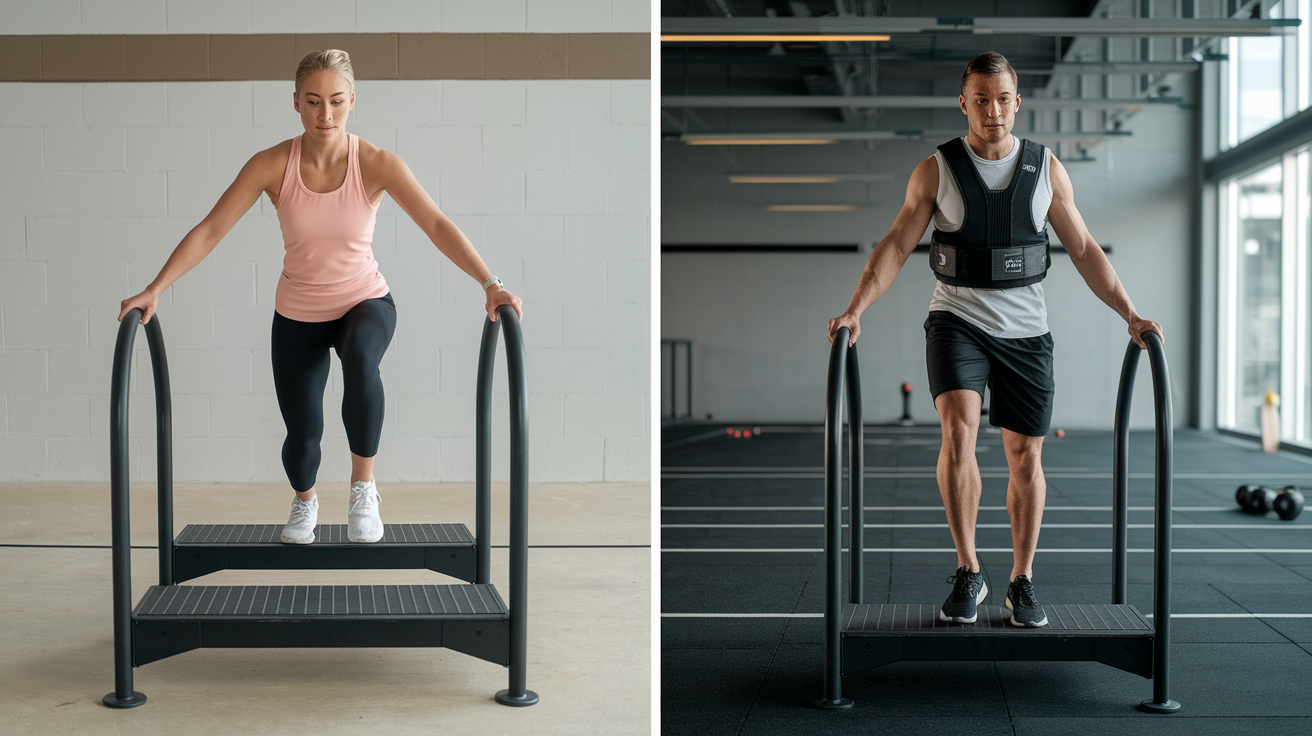
If you’re coming back from a break or managing joint sensitivity, dial back your pace and shorten your work intervals. Try 30 seconds of climbing with 30 seconds rest instead of 45/15 splits. Use a lower step height or hold the railing lightly for balance without leaning your weight into it. Marching in place can replace continuous climbs on days when your knees feel tender.
For a harder challenge, skip every other step to increase the range of motion at your hips and demand more from your glutes. Add one or two extra rounds to your session, or cut your rest periods to 10 seconds. Light hand weights or a weighted vest ramp up the intensity without changing the movement pattern. Lateral and backward steps target stabilizer muscles and add coordination work.
Knee-friendly adjustments — Use pain-free range only; if a full step-up hurts, step onto a lower surface or do a partial step where your heel touches but you don’t fully straighten your leg
Low-impact alternatives — March in place with high knees or do slow, controlled step-touches where one foot taps the step and returns to the ground without full body-weight transfer
Balance support options — Keep one hand lightly on a railing during the first two weeks; move to fingertip contact, then no contact as your stability improves
Weekly Stair Workout Structure for Time-Poor People
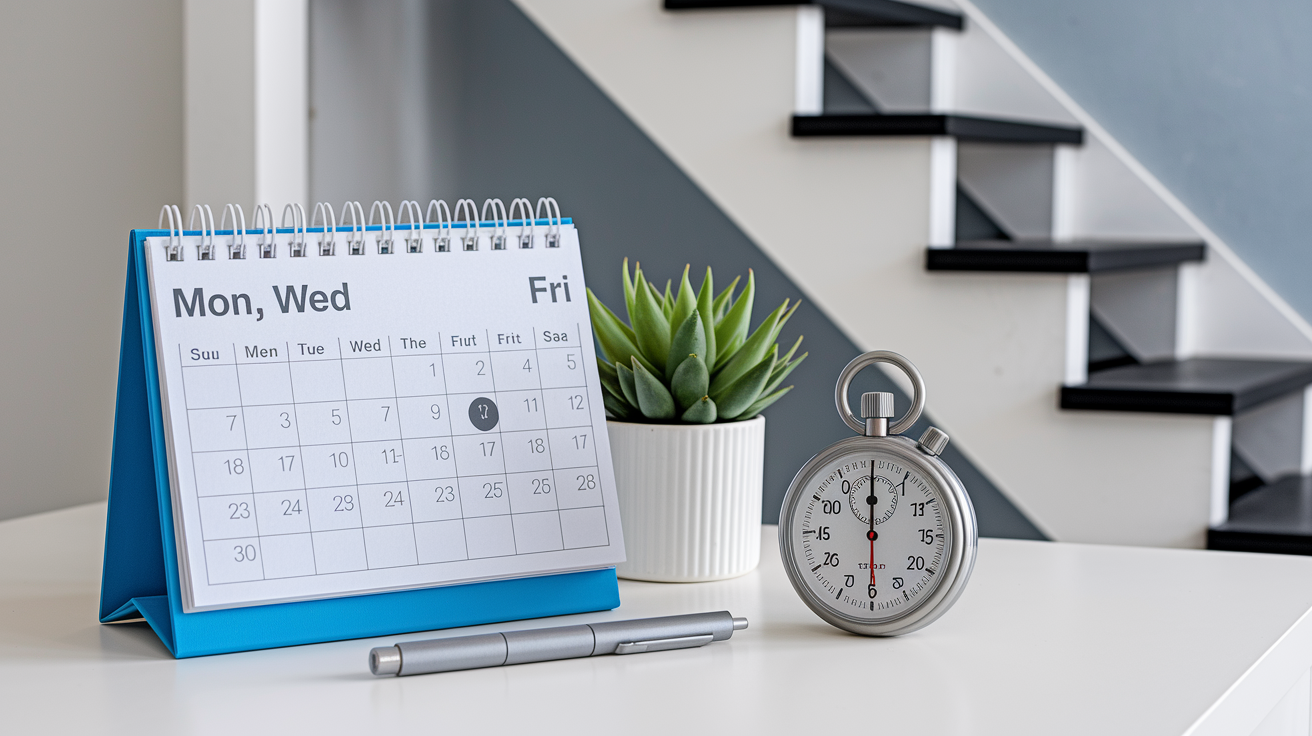
A realistic weekly plan fits stair sessions into real life without creating stress. Start with three sessions spaced across the week, like Monday, Wednesday, Friday. Each session can be as short as five minutes on a busy day or stretch to 15 when you’ve got a bit more breathing room. Rest days matter. Your muscles repair and strengthen during recovery, so don’t chase daily sessions in week one.
Add one or two minutes to your total session time each week, or toss in one extra round to your interval sets. For example, if you knock out six rounds of 45-second climbs in week one, try seven rounds in week two. Track your weekly total minutes or total flights climbed, aim to bump that number by roughly 10 percent every one to two weeks.
Weekly Layout
Two to three days should focus on moderate intervals (the 10- or 15-minute routines), and one to two days can be short recovery circuits (the 5-minute routine at an easy pace). If you prefer four or five weekly sessions, alternate between interval days and easier active-recovery days to avoid overtraining.
| Week | Focus |
|---|---|
| Week 1 | 3 sessions of 5–10 minutes; establish baseline pacing and form |
| Week 2 | 3 sessions of 10 minutes; add 1 extra round or increase work intervals by 5 seconds |
| Week 3 | 4 sessions (two 10-minute, two 5-minute); introduce lateral step-ups or backward steps on one day |
| Week 4 | 4 sessions of 10–15 minutes; reduce rest periods by 5 seconds or add a second set of upper-body moves |
Safe Form, Technique, and Common Mistakes
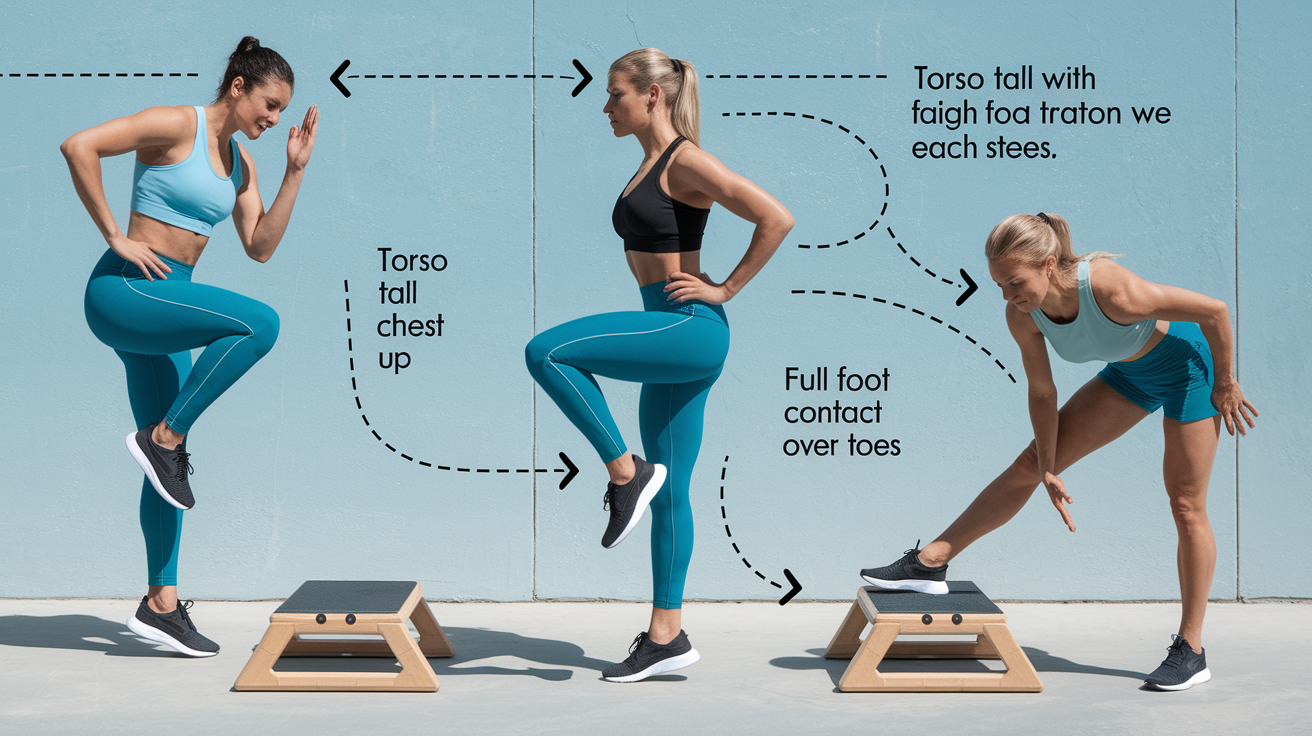
Chest up, core lightly braced on every step. Your spine stays neutral, not rounded forward or arched back. Place your entire foot on each step, heel to toe, instead of landing on your toes only. Full-foot contact activates your glutes and protects your Achilles. Don’t lock your knees at the top of each step-up. A soft bend keeps tension in your muscles and reduces joint stress.
Don’t lean heavily on the handrail. Light fingertip contact for balance is fine, but gripping the rail and pulling yourself up shifts the work away from your legs and turns the session into an arm workout. Keep your knees tracking in line with your toes. If your knee collapses inward, slow down and focus on pushing through your heel.
Landing hard on each step — Creates unnecessary impact; focus on controlled, quiet landings by engaging your quads and glutes during the descent.
Holding your breath during climbs — Breathing steadily keeps oxygen flowing to your muscles; exhale as you step up, inhale as you step down.
Rushing through reps to finish faster — Speed without control bumps up injury risk and reduces muscle activation; aim for steady pacing over frantic movement.
Ignoring pain signals — Sharp pain in your knee, ankle, or hip is a stop signal, not something to push through; if pain shows up, reduce intensity or rest.
Cool-Down and Recovery After Stair Sessions
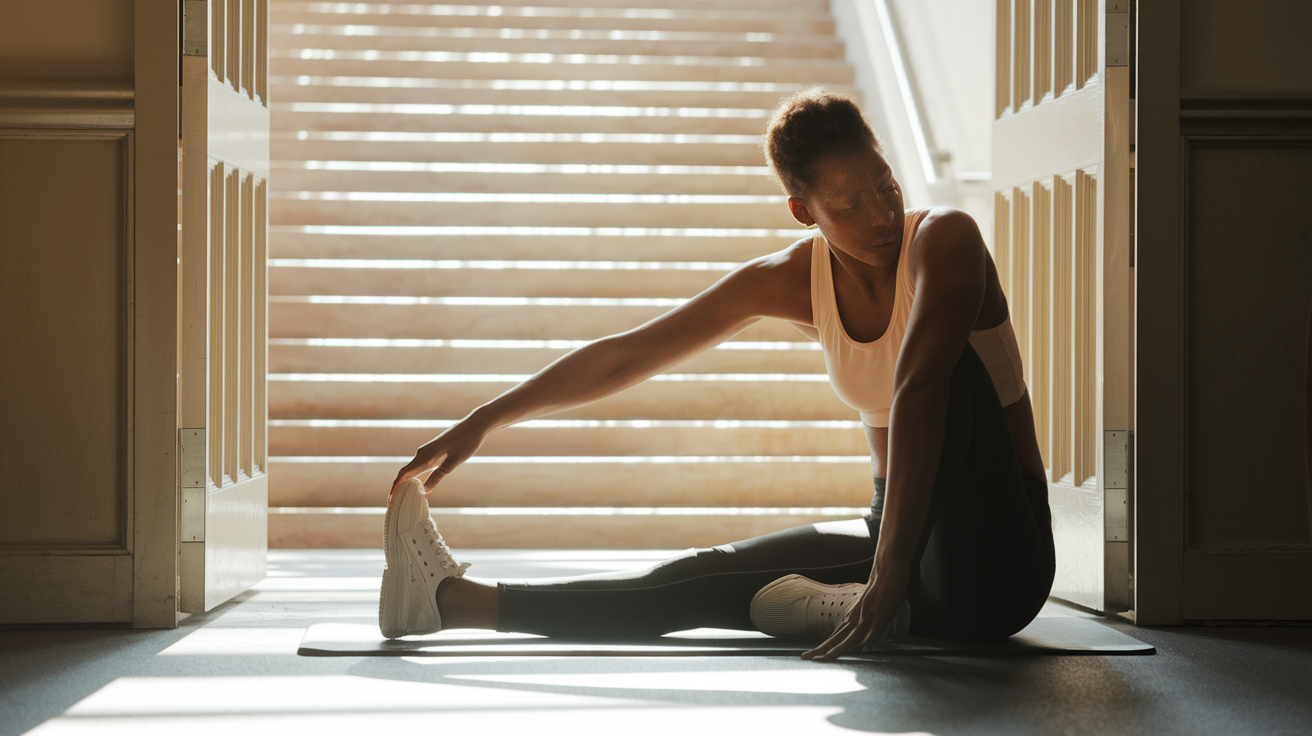
A short cool-down helps your heart rate return to baseline and cuts muscle soreness the next day. Two to five minutes is enough. Walk slowly on flat ground or march gently in place for 60 to 90 seconds, then move into static stretches.
Calf stretch — Step one foot back, press your heel into the ground, lean forward gently; hold for 30 seconds per side
Quad stretch — Stand on one leg, pull your opposite heel toward your glute, hold for 30 seconds per side
Hamstring reach — Sit on the floor with one leg extended, reach toward your toes without rounding your back too much, hold for 30 seconds
Drink water within 10 minutes of finishing your session. Light mobility work, like ankle circles or hip swings, can follow your stretches if you’ve got an extra minute. On rest days, a five-minute walk or gentle yoga sequence keeps your legs loose without adding training stress.
Tracking Progress on a Beginner Stair Routine
Write down the date, duration, and perceived exertion after each session. Perceived exertion uses a 1-to-10 scale where 1 is sitting on the couch and 10 is an all-out sprint. For beginner stair sessions, aim for a 5 to 7 most days. If your exertion stays at 3 or 4, bump up your pace or add a round. If you hit 9 or 10, pull back the intensity to avoid burnout.
Count the number of flights or total steps you climb during interval sets. If your home staircase has 12 steps and you climb it six times during a session, you completed 72 steps. Log that number and try to beat it by 10 percent the following week. Weekly totals give you a clear progress snapshot. Three 10-minute sessions might add up to 30 total minutes and 200 total steps in week one. By week four, shoot for 35 to 40 minutes and 250 to 300 steps.
Session date and time — Helps you spot patterns, like whether morning or evening sessions feel easier
Total duration — Start at 5 to 10 minutes and track increases week by week
Number of intervals or rounds completed — Shows volume improvements over time
Perceived exertion (RPE 1–10) — Captures how hard the session felt, which helps you adjust pacing and dodge overtraining
Final Words
In the action, you got a usable 5‑minute stair routine, step-by-step exercises, quick warm-up tips, and safety cues so you can start without fuss.
We also covered simple progress rules—do this 3–5 times weekly, track minutes or rounds, and use easy modifications to match your energy.
This beginner stair workout routine for time-poor people fits short gaps in your day. Try three short sessions this week and you’ll notice small wins—progress really does add up.
FAQ
Q: What is the 3 3 3 rule workout for beginners?
A: The 3 3 3 rule workout for beginners is a simple structure: pick 3 moves, do 3 sets of each, and repeat the circuit 3 times — a short, repeatable routine that’s easy to track.
Q: Does 12/3/30 actually work?
A: The 12/3/30 routine works as steady cardio: walking at 12% incline, 3 mph for 30 minutes increases calorie burn and cardio fitness when done consistently and paired with strength work.
Q: What’s a good beginner time on the StairMaster?
A: A good beginner time on the StairMaster is 5–15 minutes; start with 5 minutes at an easy pace, then build toward 10–15 minutes as your fitness improves, 3–5 times weekly.
Q: How to help a weak person up the stairs?
A: To help a weak person up the stairs, stand beside them, offer your arm or a gait belt, move one step at a time with their lead foot, let them use the handrail, and stop if they feel pain.