

Think you need an hour at the gym to get stronger?
You don’t.
One long-loop resistance band and 18 to 22 minutes give you a full-body workout that fits between meetings, while the kids nap, or in a hotel room.
This routine uses compound moves to work multiple muscles at once, so you build real strength without burning time.
You’ll get a clear 20-minute plan, safety checks, and simple progress options you can use tonight.
Quick 20-Minute Full-Body Resistance Band Workout (Start Here)
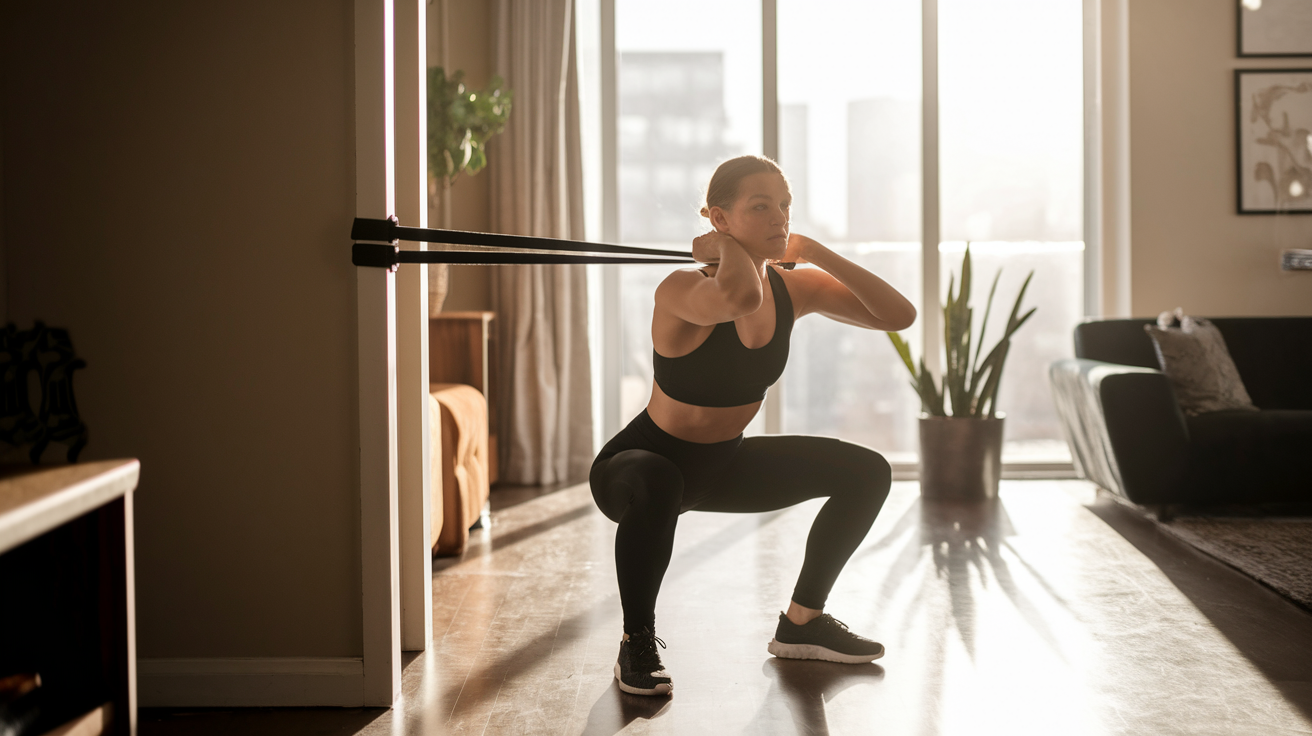
You need one long-loop resistance band and about 18 to 22 minutes. That’s it. No machines, no commute, no setup ritual. Every exercise here hits multiple muscle groups at once, which means you’re building real strength without burning an hour you don’t have.
Grab a light to medium tension band if you’re just getting started. You’ll also want a stable anchor point (door frame, post, railing) for three of the moves. If you can’t anchor anything, swap those exercises for variations where you stand on the band instead. The whole thing fits into a living room, office break room, or hotel room.
Banded squat — Stand on the band, feet hip width, hold the ends at your shoulders. 2 sets of 12 reps. Rest 45 seconds.
Banded glute bridge — Lie on your back, loop band around your thighs just above your knees, feet flat on the floor. 2 sets of 15 reps. Rest 45 seconds.
Chest press (anchor at chest height, face away) — Split stance, press your hands forward. 2 sets of 10 reps per side. Rest 45 seconds. Switch your front foot halfway through each set.
Standing row (anchor at chest height, face the anchor) — Quarter squat, pull your elbows back close to your ribs. 2 sets of 12 reps. Rest 45 seconds.
Overhead press — Stand on the band, press the ends overhead until your arms go vertical. 2 sets of 10 reps. Rest 45 seconds.
Band pull-apart — Hold the band at chest height, palms down, pull your hands apart until the band touches your chest. 2 sets of 15 reps. Rest 30 seconds.
Banded deadlift — Stand on the band, feet hip width, hinge at your hips, pull the band ends up by straightening your hips and knees. 2 sets of 12 reps. Rest 45 seconds.
Plank with band resistance — Loop the band around your wrists, hold a high plank, press your hands slightly apart to keep tension. 2 sets of 20 seconds. Rest 30 seconds.
Move through exercises 1 to 8 in order. Finish all sets of one exercise before you move to the next. Total rest across the session is around 6 minutes, leaving you with 12 to 14 minutes of actual work.
How to Perform Each Exercise With Proper Form

Banded squat — Chest up, knees tracking over your toes. Sit your hips back like you’re aiming for a chair. Press through your heels when you stand.
Banded glute bridge — Push your knees outward against the band the whole time. Squeeze your glutes hard at the top. Keep your ribs down so your lower back doesn’t overarch.
Chest press — Elbows at or just below shoulder height. Press forward in a straight line, not up or down. Keep a small split stance so you stay balanced.
Standing row — Pull your shoulder blades together first, then bend your elbows. Keep your elbows tight to your body and pause one second at the end of each rep.
Overhead press — Start with the band ends at shoulder height. Press straight up until your biceps are near your ears. Brace your core tight so your lower back stays neutral.
Band pull-apart — Keep a slight bend in your elbows. Pull the band apart using your upper back, not just your arms. Control the return. Don’t let it snap.
Banded deadlift — Hinge at your hips, not your lower back. Keep tension on the band from the start. Stand up by driving your hips forward, not by yanking with your arms.
Plank with band resistance — Body in a straight line from head to heels. Press your hands slightly outward to maintain band tension. Breathe steady and don’t let your hips sag.
Simple Progression Options for Beginners
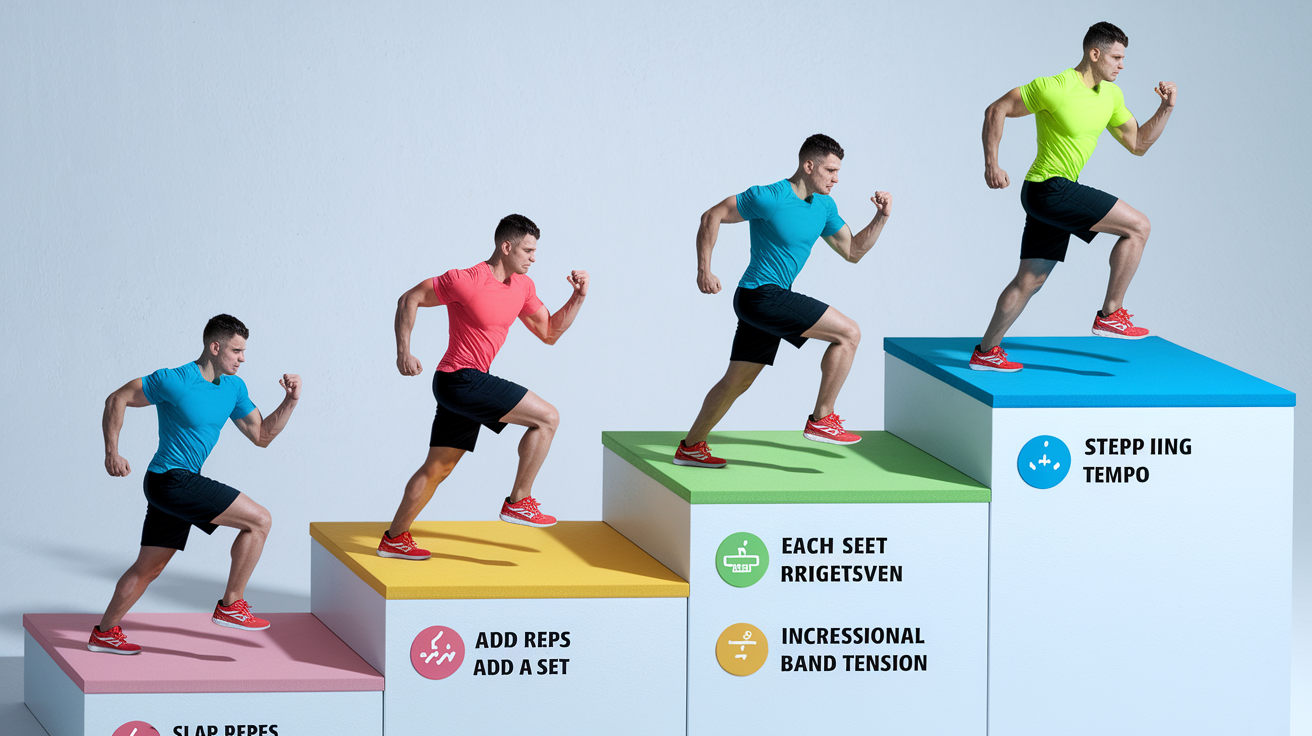
Run the listed sets and reps for your first two weeks. Once you can finish every set with good form and still have 10 to 15 seconds of rest left in your break, pick one progression method and stick with it for the next two weeks. After four weeks, you can add a second method or bump your training from three days per week to four.
| Progression Method | How to Apply It | When to Use It |
|---|---|---|
| Add reps | Increase each set by 2 reps (12 becomes 14, for example) | After two weeks of completing all prescribed reps with solid form |
| Add a set | Move from 2 sets to 3 sets on 2 or 3 exercises | When you finish the routine with 3 to 5 minutes to spare |
| Increase band tension | Step further from the anchor or use a heavier resistance band | When the last 3 reps of each set feel easy and you’re not breathing hard |
| Slow the tempo | Lower for 3 seconds, lift for 1 second on each rep | If you want more muscle fatigue without adding time or gear |
Weekly Scheduling Tips for Busy People
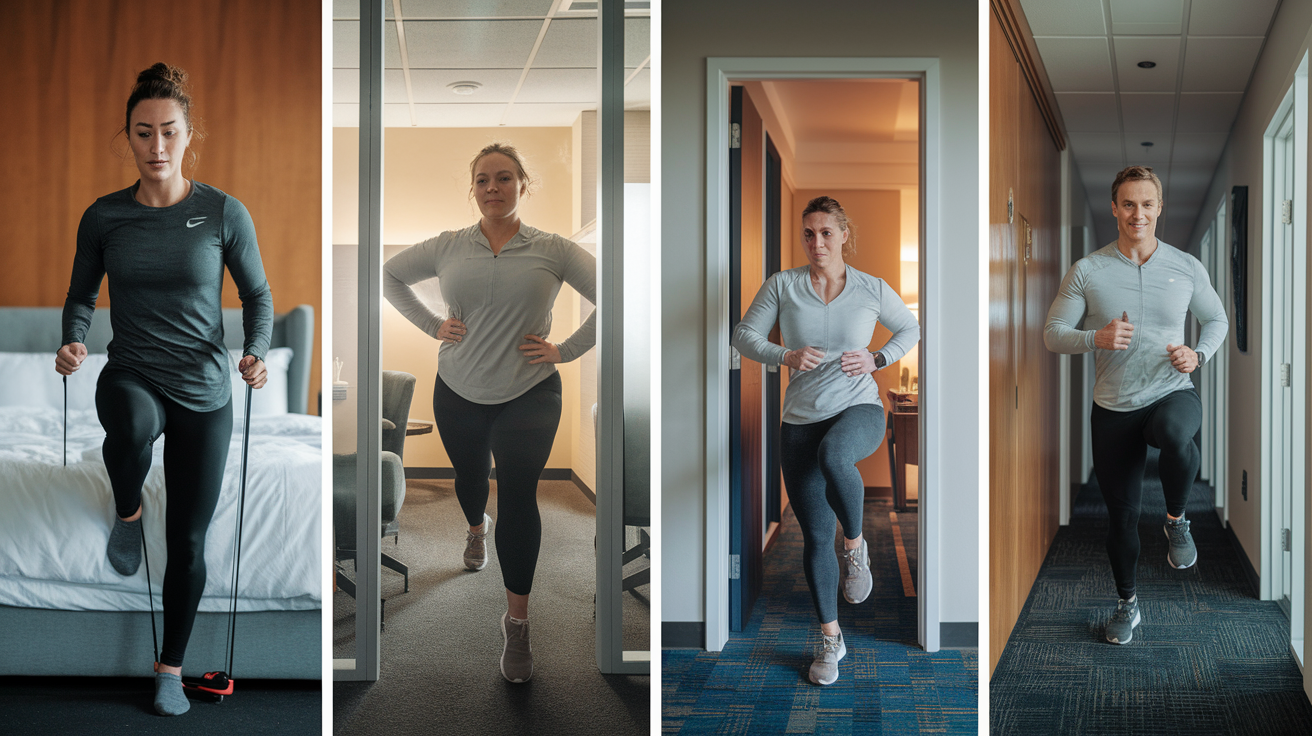
Three to four sessions per week is enough to build strength and lock in the habit. Consistency beats intensity every time, so pick a realistic number of days and don’t move them around for at least four weeks. Most people feel noticeable changes in how exercises feel within two to three weeks if they’re hitting three sessions weekly.
If your schedule is unpredictable, aim for a minimum of two sessions per week. Treat a third or fourth session as a bonus. Two workouts will keep your strength stable and your movement patterns fresh. Three or more will build strength steadily.
Morning routine — Do the workout right after you wake up, before breakfast or email. Keep your band next to your bed or coffee maker.
Lunch break session — Use 20 minutes in the middle of your workday. Close your office door or find a quiet corner in the break room.
Micro workouts — Split the routine in half. Four exercises in the morning, four in the evening. Each block takes about 10 minutes.
Travel routine — Pack your band in your carry-on. Use a hotel room door frame or hallway railing as your anchor. Schedule the session right before or after dinner.
Alternating days — Monday, Wednesday, Friday. Or Tuesday, Thursday, Saturday. Pick the pattern that fits your standing commitments and don’t shift it around each week.
Safety Basics for Resistance Band Beginners

Warm up for three to five minutes before you start. Walk in place, do arm circles, or run through each exercise with no band for 5 to 8 reps. Cold muscles strain easier, and a short warm-up makes the first set feel smoother.
Check your band before every session. Look for small tears, worn spots, or chalky texture. If you see damage, replace it. When you’re anchoring, loop the band around a solid post or through a closed door at the hinge side, never the handle side. Test the anchor with a gentle pull before your first rep.
Keep your movements controlled on both the way up and the way down. Don’t let the band snap back. If your form breaks down in the last few reps, stop the set. You can always add reps next week. Protect your joints by keeping a small bend in your elbows and knees at the end range of each exercise. Never lock out completely under tension.
Printable 20-Minute Workout Cards
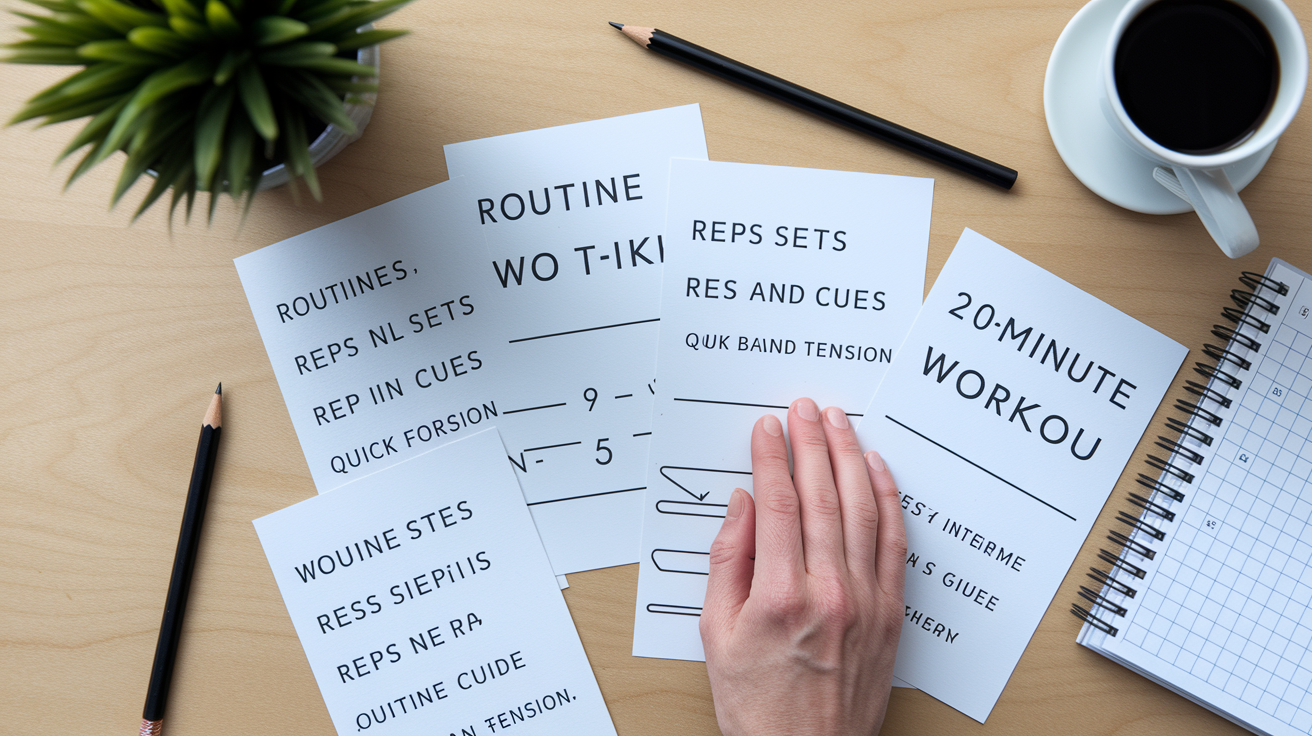
The workout cards give you a one-page reference you can tape to a wall, keep on your phone, or fold into your gym bag. Each card lists the exact workout you need for that day. No scrolling through articles or trying to remember exercise names.
Routine steps — Exercises listed in order, numbered 1 to 8, with checkboxes next to each.
Reps and sets — Clear prescription for every exercise, formatted as “2 × 12” or “2 × 20 sec” so you know exactly what to do.
Rest intervals — Rest time printed next to each exercise so you can glance and start your timer.
Quick form cues — One or two reminder phrases per exercise, like “chest up, knees out” or “pull shoulder blades first.”
Band tension guide — Color or resistance level recommendation (light, medium) printed at the top of the card.
Weekly plan — A small calendar showing which days to train and which days to rest, with space to check off completed sessions.
Final Words
Jump into the 20-minute full-body resistance band workout tonight. It covers squats, rows, presses, glute bridges, and core moves so you get a full session in one short block.
Stick to the form cues, use the simple progressions, and pick a weekly slot you’ll actually keep. If you’re rushed, do one circuit or the minimum effective option.
This resistance band beginner routine for busy schedules gives a clear, repeatable plan you can track and improve week to week. Small steps add up—you’re set to get stronger.
FAQ
Q: What is a quick 20-minute full-body resistance band workout?
A: A quick 20-minute full-body resistance band workout is a short, structured routine using bands to hit legs, back, chest, glutes, shoulders, and core with compound moves for strength and mobility you can finish in one session.
Q: Which exercises are included in the 20-minute routine?
A: The 20-minute routine includes banded squats, bent-over rows, chest presses, glute bridges, Romanian deadlifts, shoulder presses, band pull-aparts, resisted planks, and a core rotation for a complete full-body session.
Q: What equipment do I need for this beginner band workout?
A: The equipment needed for this beginner band workout is 1–2 loop or tube bands (light and medium), a secure anchor or door attachment, and a mat or soft floor for comfort.
Q: How should I perform the exercises with proper form?
A: Proper form means keeping a neutral spine, controlled band tension, stable joints, full range of motion, and steady breathing; move slowly and prioritize technique over extra reps or heavier bands.
Q: How can beginners progress the routine over 4–8 weeks?
A: Beginners can progress by increasing band tension, adding 2–4 reps, slowing tempo for more time under tension, or adding a set; use each change when current sets become easy for two sessions.
Q: How often should busy people do this workout each week?
A: Busy people should do this workout 3–4 times weekly, spacing sessions with at least one rest day between, or opt for two focused sessions plus short micro-workouts on other days.
Q: How do I complete the routine as a circuit?
A: Completing the routine as a circuit means performing each exercise back-to-back with minimal rest, then resting 60–90 seconds between rounds; aim for 2–3 rounds of the full sequence.
Q: What basic safety steps should beginners follow with bands?
A: Basic safety steps are to warm up, inspect bands for damage, use secure anchors, maintain controlled motion, protect joints by avoiding sudden snaps, and stop for sharp pain—see a clinician for concerns.
Q: What do the printable 20-minute workout cards include?
A: The printable workout cards include the full routine steps, sets and reps, rest times, brief form cues, suggested band levels, and a simple weekly plan for quick reference during sessions.
Q: Can absolute beginners or people with past injuries use resistance bands?
A: Absolute beginners or people with past injuries can use resistance bands by starting very light, focusing on form, using fewer reps, and checking with a clinician if you have recent or serious injuries.